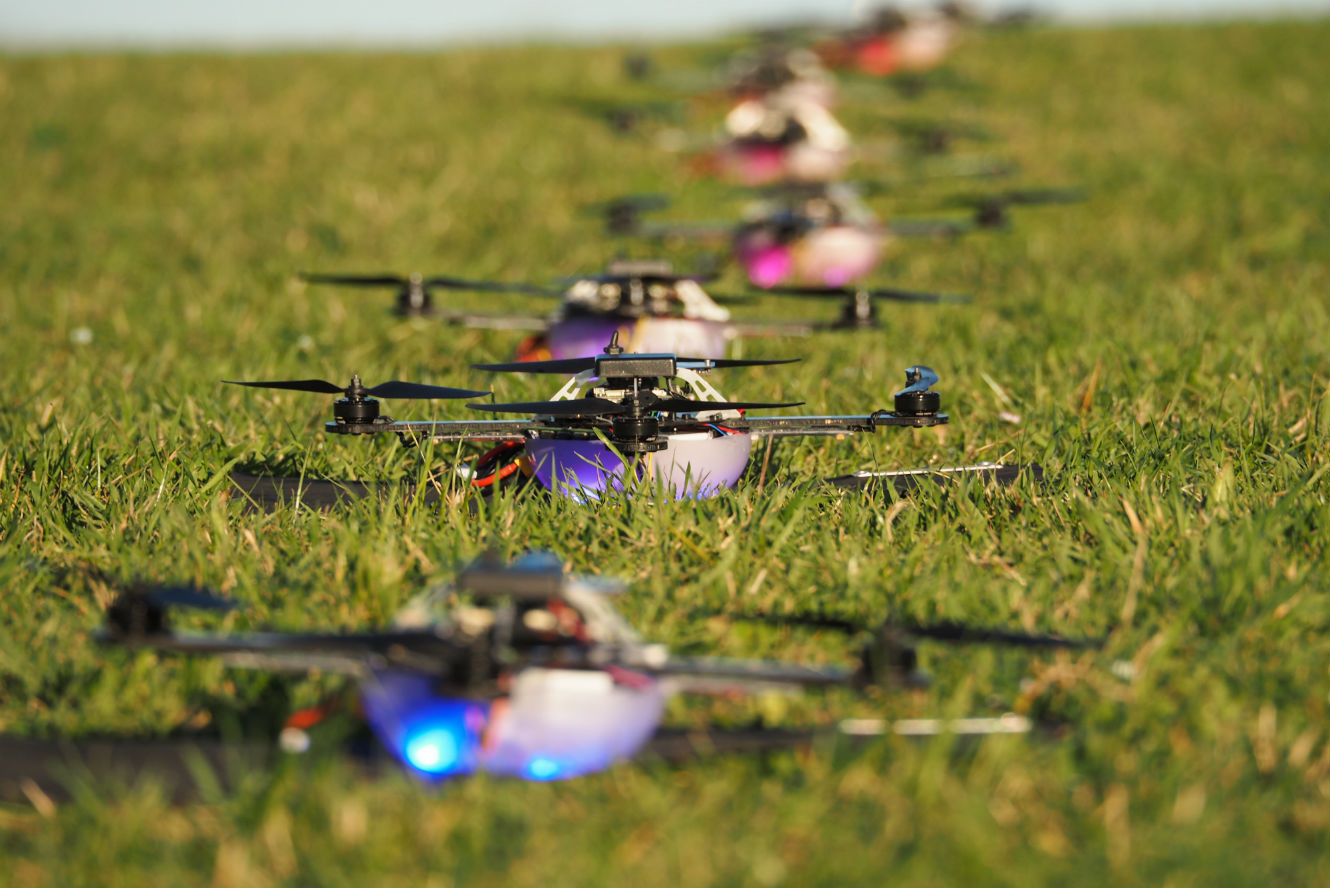
Military units are expected to begin deploying drone swarms within the next two years as the technology reaches maturity, according to both the French Army’s lead officer for emerging defense innovations and the Thales executive overseeing drone–warfare development.
Eric Lenseigne, vice president for drone warfare at Thales, told attendees at last week’s Forum Innovation Défense in Paris that “within two years, we’ll see genuine operational use in select units, followed quickly by broader adoption, because the advantages of swarming systems will be unmistakable.”
Col. Philippe Bignon, who heads the Exploration Bureau within the French Army’s Future Combat Laboratory, explained that drone swarms can overcome two defining features of modern conflict: access-denial measures and the extreme lethality found on front-line contact zones. Although several NATO countries in Europe are experimenting with swarm concepts—and Ukraine has reportedly employed small groups of drones—most current unmanned systems still rely on one operator per drone. True swarm operations, however, involve AI-driven groups of drones working cooperatively, making decisions and executing tasks with limited human input.
Lenseigne noted that Thales’ research indicates the industry is “on the verge” of enabling functional swarms, emphasizing that nearly all required technological components already exist.
According to Bignon, initial military swarm capabilities should emerge within two years, with full-scale deployment expected in roughly five. France is already developing its first autonomous robotic combat unit under the Pendragon program, which integrates ground and aerial drones with AI-enabled command systems. A first demonstration is planned for 2026, with operational use anticipated in 2027.
Swarms reduce risk by distributing tasks across numerous drones, Bignon said, noting that only a portion of the group needs to succeed for the mission to be accomplished. AI will also enable automatic reassignment of leadership roles if the designated lead drone is destroyed.
To break through access-denial barriers, Bignon described “complex swarm raids” that would combine suppression of air defenses, electromagnetic disruption, and strikes on communication networks, logistics routes, and command infrastructure—ultimately creating openings for exploitation forces.
“This approach to penetration operations will be central to solving the tactical stalemate we’re witnessing in Ukraine,” he added.
Although drones have been used extensively in Ukraine, their operational style has changed little, Lenseigne said—pilots generally control each drone manually from start to finish. He argued that swarm capabilities are not advancing rapidly on the Ukrainian battlefield, where the overwhelming number of drones still requires a corresponding number of human operators.
Bignon agreed that Ukraine has not yet fielded large-scale swarms. He expects smaller groups of five to 10 coordinated drones—something Ukrainian engineers are actively developing—to appear before true mass swarms involving hundreds or thousands of units.
Swarms could also be used to resupply troops pinned down by the intense lethality of the Ukrainian front, where anything detected near the line of contact can be destroyed in minutes. They could support deception efforts as well.
According to Bignon, the automation and robotization of the Ukrainian front will only accelerate, pushing combat toward zones where machines operate with minimal or no human presence, creating areas of extremely high lethality.
Lenseigne described a future battlefield where a small number of highly advanced manned platforms operate alongside vast numbers of inexpensive unmanned vehicles moving in swarms.
However, ethical challenges loom large. “Swarms inherently involve artificial intelligence,” Bignon said, meaning operators must understand how AI might behave unpredictably, retrain systems when needed, and assume legal responsibility for outcomes.
He also warned that the psychological effects—on both those using swarms and those encountering enemy swarms—are often overlooked. He likened swarm warfare to the “dehumanized combat” experienced by French troops facing suicide attackers, noting that the emotional detachment can be unsettling.
Lenseigne added that integrating swarm technology will require significant human adaptation, as it fundamentally alters how soldiers approach combat and military systems.
Logistical hurdles also remain—such as storing and transporting hundreds of drones, powering them before missions, and integrating all necessary hardware. A substantial support ecosystem will need to be built, he said.
“These issues may seem minor compared to creating advanced AI systems,” Lenseigne concluded, “but in practice, they present very real and very physical challenges.”