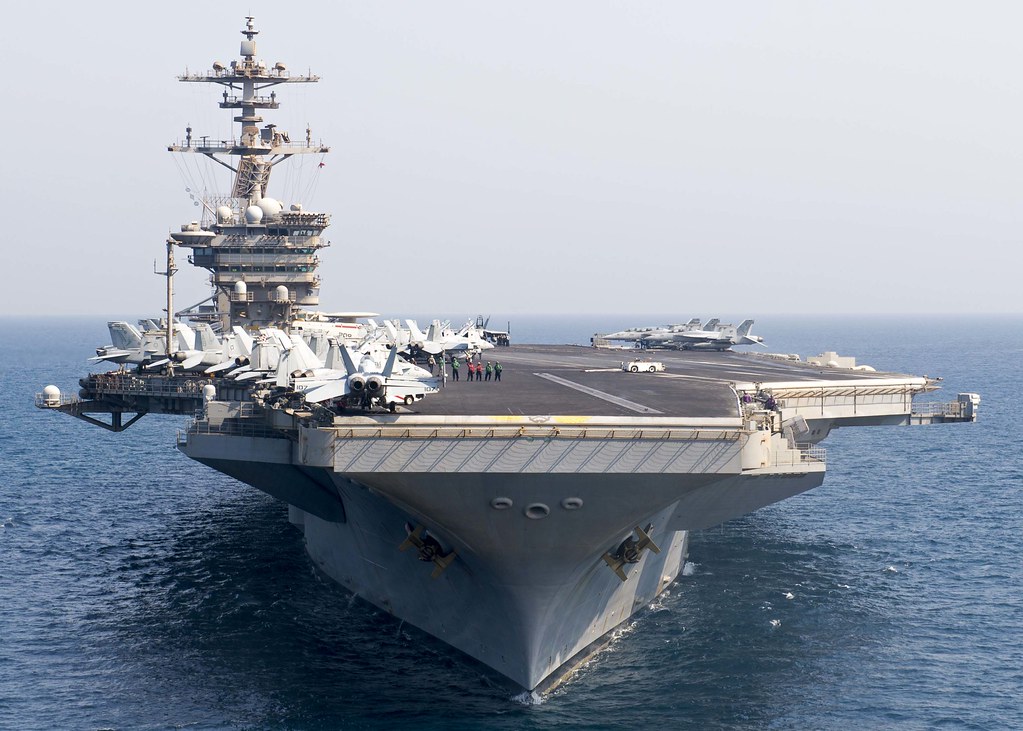
The USS Theodore Roosevelt has become the first U.S. Navy aircraft carrier equipped with an Unmanned Air Warfare Center (UAWC) capable of supporting operations involving Boeing’s MQ-25A Stingray, the Navy’s first operational carrier-based unmanned aircraft.
The development comes as the Navy advances the MQ-25A toward deployment. In May, then-acting Navy Secretary Hung Cao told the Senate Armed Services Committee that the Stingray had entered the low-rate initial production and deployment stage.
Designed primarily as an aerial refueling platform, the MQ-25A is intended to take over the tanker mission currently performed by the Navy’s F/A-18 Super Hornets. By handling refueling duties, the unmanned aircraft will allow F/A-18E/F fighters to devote more time to strike and combat missions.
A Pentagon acquisition report dated April 21, 2026, and released recently as part of its Modernized Selected Acquisition Report, states that the Theodore Roosevelt’s UAWC achieved full operational and deployment readiness for the MQ-25 in March. The report also says a second UAWC aboard the USS Ronald Reagan is expected to reach operational and deployable status by the end of August 2026.
The Nimitz-class USS George H.W. Bush was the first carrier to receive and test a UAWC when the system was installed aboard the ship in August 2024. The Navy says the center combines the Unmanned Carrier Aviation Mission Control System with the MD-5E Ground Control Station, providing the command-and-control capabilities needed to operate the MQ-25.
The Stingray reached another major milestone in May when it achieved Milestone C. Under the U.S. defense acquisition system, that designation allows a program to move from engineering and manufacturing development into production and deployment. For the MQ-25, reaching this stage marks a significant step forward after nearly eight years of development.
The Navy awarded Boeing an $805 million contract in 2018 covering the design, development, manufacture, testing and delivery of four MQ-25 aircraft. At the time, the service estimated that acquiring a fleet of 72 Stingrays would cost approximately $13 billion.
The program has experienced delays, including a first flight that took place later than originally scheduled. Nevertheless, the MQ-25 moved closer to operational service on April 25 after completing a roughly two-hour test flight near Mascoutah, Illinois.
With the Theodore Roosevelt now equipped to support the Stingray and the MQ-25 program progressing toward deployment, the Navy appears increasingly close to putting its carrier-based unmanned refueling aircraft into operational service.