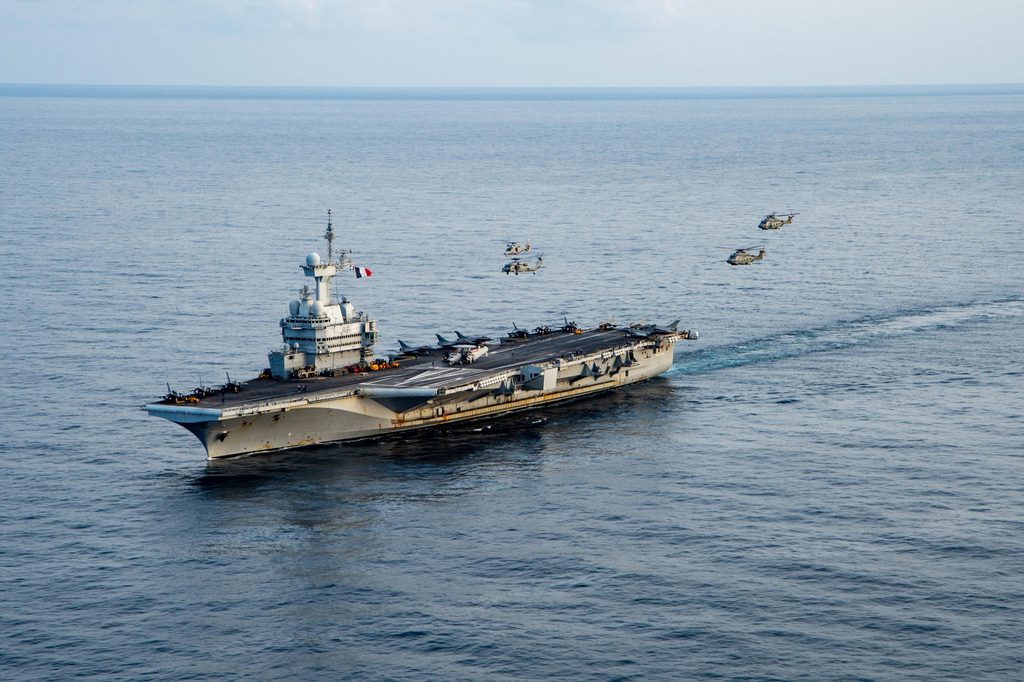
France is examining the possibility of keeping its nuclear-powered aircraft carrier, Charles de Gaulle, in service beyond its planned retirement in 2038. Such an extension could allow the French Navy to operate two aircraft carriers simultaneously for a limited period, Chief of Staff Adm. Christophe Cluzel told the National Assembly’s Defence Committee.
The French Navy is scheduled to replace the Charles de Gaulle with a new-generation aircraft carrier named France Libre in 2038. As part of the current carrier’s next major refit, officials will assess whether its operational life can be extended, taking into account the condition of its onboard systems and nuclear propulsion infrastructure.
The Charles de Gaulle is the only operational nuclear-powered aircraft carrier outside the United States Navy. Because France currently operates just one carrier, it temporarily loses its carrier-based aviation capability whenever the vessel enters port for scheduled maintenance. The question of acquiring or maintaining a second carrier has therefore remained a recurring subject of parliamentary debate.
However, the financial implications are considerable. The projected cost of the France Libre programme is approximately €10 billion (US$11.2 billion), an amount that could alternatively finance at least ten new Defence and Intervention Frigates (FDI).
Addressing lawmakers, Cluzel explained that two carriers would enable France to maintain a standing alert capability from Toulon, the Charles de Gaulle’s home port in southern France. He acknowledged that operating two carriers represents a political and strategic choice rather than a decision for the Navy chief alone. He also pointed out that maintaining an uninterrupted carrier presence at sea would require a fleet of three vessels.
The planned transition between the two carriers is expected to create a period of overlap from 2036 to 2038. During these two years, both vessels would be available, with separate crews serving on the two platforms. According to Cluzel, this arrangement is essential to preserving operational expertise and ensuring that the transition to the new carrier takes place without a loss of specialist skills.
France last operated two aircraft carriers simultaneously in the late 1990s, when the conventionally powered Foch and Clemenceau were in service. Cluzel warned that any interruption in carrier operations could result in the loss of capabilities that would take considerable time to rebuild.
The future France Libre will be significantly larger than the existing carrier. French plans call for a length of approximately 310 metres and a displacement of around 80,000 tonnes, compared with the Charles de Gaulle’s 261.5-metre length and displacement of about 42,000 tonnes.
The current carrier can accommodate an air wing of approximately 40 aircraft, primarily naval Rafale fighters, alongside two E-2C Hawkeye airborne early-warning aircraft and several helicopters.
The service-life extension assessment will focus on the condition of the Charles de Gaulle’s nuclear reactor cores and whether the propulsion system can support additional years of operation without requiring premature refuelling. Cluzel said the findings are expected in early 2029 and will determine whether an extension is technically feasible.
The investigation will also cover the ship’s auxiliary and supporting systems. Cluzel stressed that the carrier’s availability depends not only on its main propulsion plant but also on the reliability of the numerous systems required to keep the vessel operational. The assessment will therefore examine the ship comprehensively rather than concentrating solely on its reactors.
France Maintains Electromagnetic Catapult Plans
France intends to proceed with plans to equip the France Libre with US-manufactured electromagnetic aircraft launch systems, despite US President Donald Trump’s order directing the US Navy to return to steam-powered catapults. Cluzel said he expected to discuss the issue with US Navy counterpart Adm. Daryl Caudle during a planned meeting in Washington.
The French Navy chief defended electromagnetic catapults, citing their operational record. According to him, the systems have completed nearly 40,000 launches since entering US service, with availability approaching 98%. He highlighted their flexibility and ability to launch heavier aircraft as well as uncrewed aerial systems.
Cluzel said he did not believe the contract was in jeopardy. The United States already operates three nuclear-powered carriers equipped with electromagnetic catapults and arresting systems, meaning that manufacturing, maintenance and repair capabilities are established.
Nevertheless, France wants to reduce its dependence on foreign suppliers wherever possible. Following the approach adopted for the steam catapults installed on the Charles de Gaulle, France plans to acquire a substantial stock of spare parts for the new electromagnetic systems at the beginning of the France Libre programme. This would help the country carry out maintenance and repairs with greater independence.
Cluzel also ruled out the need for France to operate short-takeoff and vertical-landing aircraft, arguing that such designs can involve compromises in range or weapons-carrying capacity. Instead, the France Libre is intended to be a carrier optimised for establishing air and maritime superiority, a role that nuclear propulsion, catapult-assisted launches and arresting cables are designed to support.
With air and maritime dominance increasingly contested across multiple regions, Cluzel argued that establishing local superiority must be an early objective in military operations. At sea, he said, an aircraft carrier provides a crucial means of generating air power in areas far from land-based airfields.
French Navy Praises New FDI Frigate
Cluzel also offered a positive assessment of France’s new Frégate de Défense et d’Intervention (FDI), or Defence and Intervention Frigate, built by Naval Group. Responding to criticism from competing industrial interests, he said the vessel had demonstrated strong seakeeping and stability.
He particularly praised the frigate’s flat-panel radar, describing its detection performance as remarkable and at least comparable to that of the radar systems fitted to France’s dedicated air-defence frigates, despite the FDI radar being positioned closer to the waterline.
The vessel’s digitally integrated processing architecture also offers significant improvements in sonar detection, according to Cluzel. These capabilities are intended to strengthen the frigate’s ability to detect and respond to threats while supporting the French Navy’s broader modernisation efforts.