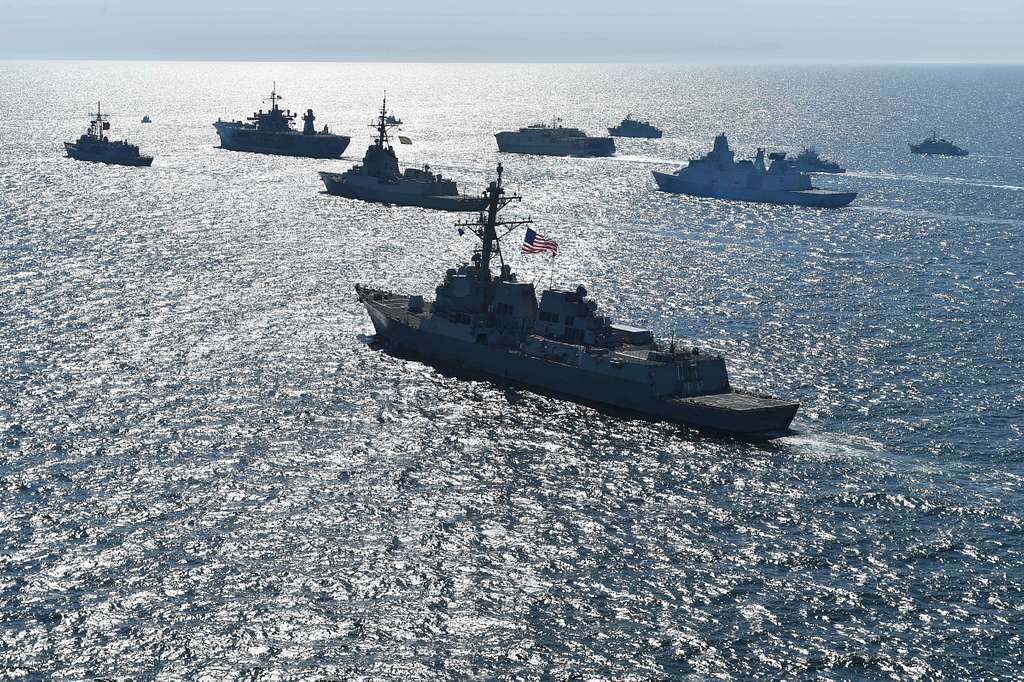
The above image is for representational purposes only.
European governments have declined to deploy naval forces to the Strait of Hormuz, even as Donald Trump warned that NATO could face serious consequences if allies failed to help restore access to the crucial shipping route.
Germany firmly rejected any involvement in military operations, including efforts to reopen the passage. Chancellor Friedrich Merz stated that no collective decision had been made regarding intervention, making German participation irrelevant. While he criticized Iran’s leadership, he cautioned that military strikes were unlikely to produce a lasting solution.
Defence Minister Boris Pistorius echoed this stance, emphasizing that the conflict was not Germany’s responsibility. He questioned the effectiveness of a limited European naval presence, suggesting it would add little to the capabilities of the United States Navy.
UK Prime Minister Keir Starmer said Britain would avoid being pulled into a broader conflict but was exploring practical options to address the situation. He stressed that reopening the strait to stabilize global oil markets would require coordination among multiple partners.
Across Europe, leaders have prioritized diplomatic channels to restore operations in the waterway, which previously handled roughly 20% of global oil and liquefied gas flows before Iran’s blockade. Italy’s Foreign Minister Antonio Tajani reinforced this approach, stating that diplomacy should take precedence and ruling out extending existing EU naval missions beyond their current defensive and anti-piracy roles.
The cautious position of major European powers stands out, particularly as they had largely refrained from criticizing Trump’s earlier decision—alongside Israel—to strike Iran, a move that escalated into a wider regional conflict and drove up energy prices.
Other nations, including Australia, France, and Japan, have similarly indicated they do not intend to send warships.
Trump, however, has continued urging allies to contribute naval support, arguing that countries benefiting from the strait should help safeguard it. He warned that a lack of cooperation could negatively impact NATO’s future.
Meanwhile, EU foreign ministers opted not to expand the mandate of their Red Sea mission, Operation Aspides, to include the Strait of Hormuz. EU foreign policy chief Kaja Kallas noted there was interest in strengthening the mission but no agreement to broaden its scope.
European officials have also called for greater clarity on US and Israeli strategic objectives. Estonia’s foreign minister, Margus Tsahkna, said allies wanted a clearer understanding of Washington’s long-term plan.
Greece, which hosts the headquarters of Operation Aspides, confirmed it would not participate in any military action in the strait.
On the ground, Israel has intensified its military campaign, launching large-scale strikes on infrastructure in Tehran, Shiraz, and Tabriz. It also claimed to have destroyed an aircraft previously used by Iran’s late supreme leader at Tehran’s Mehrabad airport. Israeli officials said the plane had been used by senior leadership for travel and coordination.
An Israeli military spokesperson said detailed operational plans were in place for the coming weeks, aimed at weakening Iran’s governing system and dismantling its security capabilities.
The conflict is increasingly affecting the wider Gulf region. A drone strike triggered a fire at the UAE’s Fujairah port, temporarily halting oil-loading operations at a facility responsible for about 1% of global supply. Another drone-related incident near Dubai airport ignited a fuel tank and briefly disrupted flights.
In Israel, air raid sirens were activated after an Iranian missile was intercepted, with debris falling near Tel Aviv and explosions heard in Jerusalem.
Iranian Foreign Minister Abbas Araghchi dismissed suggestions that Tehran was seeking a ceasefire, stating that while Iran does not desire war, it intends to ensure such attacks are not repeated. Deputy Foreign Minister Saeed Khatibzadeh warned the US against deploying ground troops, drawing a comparison to the Vietnam War.
The United States reported that around 200 of its troops had been injured during the conflict, with most returning to duty, while 13 had been killed since late February. Human rights groups estimate that over 1,800 people have died in Iran, including a significant number of civilians.
Israel has also expanded its ground operations in southern Lebanon following rocket attacks by Hezbollah. Casualty figures in Lebanon have surpassed 850, including more than 100 children.
Germany, despite being a strong supporter of Israel, criticized the expansion of ground operations in Lebanon, warning it could worsen an already fragile humanitarian situation and urging restraint.