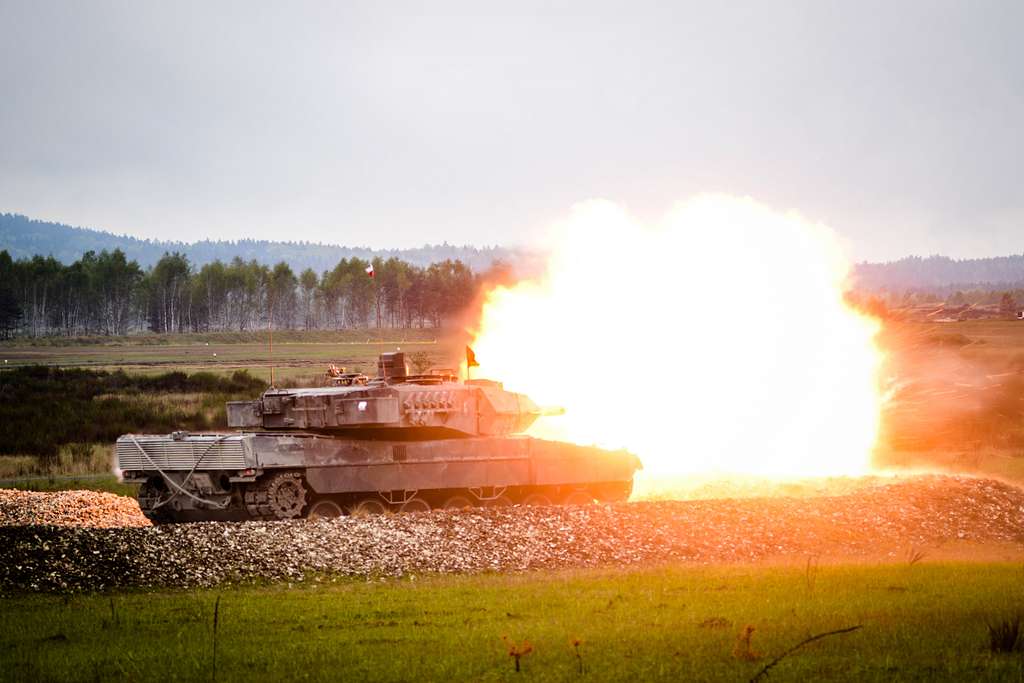
The above image is for representational purposes only.
France is exploring an interim option with industry partners to replace its aging Leclerc main battle tanks, as delays continue to affect the joint program with Germany to develop a next-generation system. Armed Forces Minister Catherine Vautrin informed lawmakers that the planned Main Combat Ground System (MGCS), originally intended to succeed the Leclerc, is running roughly ten years behind schedule. She also outlined plans for an additional €36 billion in defense spending between 2026 and 2030.
According to Vautrin, the delay stems partly from Germany launching its own Leopard 3 tank program. This has created a capability gap between the Leclerc’s expected retirement around 2038 and the projected arrival of MGCS, which is unlikely before the early 2040s. France is therefore considering a transitional solution designed not as an extension of older technology, but as a foundation for the next generation of integrated combat systems, with a strong emphasis on digital connectivity.
The interim tank could combine a platform developed by KNDS Germany with a turret produced by KNDS France. Discussions between France’s Directorate General for Armament and industry stakeholders are still in the early stages.
The proposed funding increase is part of a revision to France’s military planning law, which had initially allocated €400 billion for the 2024–2030 period.
On the Future Combat Air System (FCAS)—a joint effort involving France, Germany, and Spain—Vautrin said mediation is underway to resolve disputes between Dassault Aviation and Airbus over leadership roles and division of work. Progress on the next-generation fighter jet has stalled due to disagreements, and external mediators are now addressing key issues such as intellectual property, responsibilities, and certification. These discussions are expected to conclude by the end of April.
Dassault CEO Éric Trappier indicated that talks with Airbus are ongoing to find a way forward but reiterated his opposition to shared management. Spain’s involvement in the FCAS program has shifted the balance toward Airbus, which Trappier claims has resisted Dassault’s previously agreed leadership role.
Lawmakers also raised concerns about the Eurodrone program, led by Airbus, which has faced repeated delays and is no longer included in the updated budget. Vautrin acknowledged that progress has been unsatisfactory, and the government has also canceled plans to acquire Safran’s Patroller drone.
France plans to accelerate procurement of the SAMP/T NG air-defense system, aiming to field ten units by 2030 instead of the originally planned eight, while maintaining a target of twelve systems by 2035. The government is also maintaining its goal of deploying 225 Rafale fighter jets by 2035 across the Air Force and Navy. Rather than expanding purchases of the current F4 standard, the focus will shift to the future F5 configuration, which will be capable of carrying the ASN4G hypersonic nuclear missile.
An additional €3.5 billion is allocated to modernize combat aviation through a combination of long-range weapons, drone escorts, and enhanced connectivity—measures intended to keep the Rafale competitive internationally. The F5 upgrade is described as a significant mid-life enhancement to sustain the aircraft’s operational relevance.
The revised plan also increases the number of multiple launch rocket systems to 30 by 2030, up from a previous target of 16. France will test two domestically developed rocket artillery systems this month to determine whether a national solution is viable or if an off-the-shelf system should be acquired. Competing projects are being developed by Safran and MBDA, as well as by Thales in partnership with ArianeGroup.
Additionally, €1 billion has been earmarked to begin developing a conventional long-range ballistic strike capability. This year, the Armed Forces Ministry plans to order 10,000 combat drones, 43 anti-drone cannons, four SAMP/T NG systems, and €4 billion worth of additional air-defense equipment focused on countering drone threats. Deliveries scheduled for 2026 include 5,000 combat drones, three anti-drone laser systems, and two Airbus A400M transport aircraft.
Vautrin also highlighted progress within the defense industry, noting that manufacturers are scaling up production. MBDA, for example, aims to quadruple output of its Mistral 3 short-range air-defense missiles to 800 units annually by 2028, and to increase production of Scalp cruise missiles from 240 in 2025 to 360 by 2027.