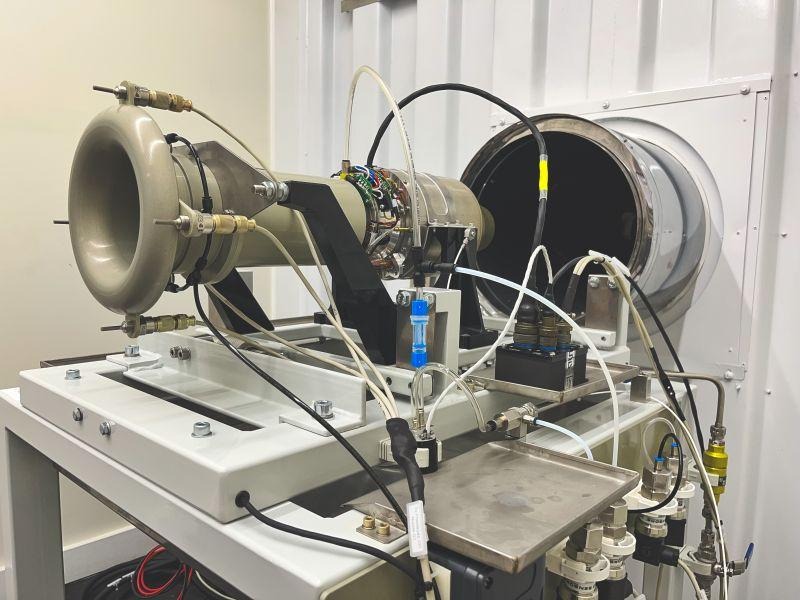
Czech jet engine manufacturer PBS Aerospace is preparing to substantially increase its manufacturing capacity in the United States, with plans to at least double its current production capability as demand grows for compact propulsion systems used in drones and cruise missiles.
Jan Havránek, the company’s chief government relations and strategy officer, told Defense News that rising demand is creating pressure on manufacturers to deliver engines in greater numbers without compromising quality or production standards.
He said that customers increasingly want drones and missiles capable of travelling faster and farther, while expecting delivery within shorter timeframes. The conflicts taking place around the world, particularly the war in Ukraine, have also highlighted the importance of establishing dependable domestic sources of propulsion systems for the US market.
According to Havránek, these developments have made manufacturing scale and product quality central considerations for the industry.
PBS Aerospace US expansion centres on Georgia facility
PBS Aerospace continues to manufacture engines at its established facility in Velká Bíteš, Czech Republic. However, the company has also been building its presence in the American market.
In September 2025, it opened a manufacturing plant in Roswell, Georgia, following an investment of $20 million. The facility was established to serve US customers, with the American government identified as its ultimate customer.
Havránek said the company’s approach is to manufacture engines within the United States primarily for the domestic market. PBS Aerospace supplies engines to major defence contractors that, in turn, provide systems to the US Department of War.
He described the Georgia operation as part of the company’s contribution to strengthening America’s defence industrial base and bringing strategically important manufacturing capabilities back into the country.
PBS Aerospace’s partners in the United States include Lockheed Martin and Pratt & Whitney.
Production target of up to 20,000 engines annually
The company is planning a substantial increase in output at its Roswell plant over the coming three years. Its target is to reach annual production of between 10,000 and 20,000 engines.
As an intermediate step, PBS Aerospace is looking at producing as many as 5,000 engines in the United States next year, according to Havránek.
Supporting this expansion will require a significant increase in manufacturing capacity. The company is therefore considering an investment of approximately $100 million in its Roswell operations.
The proposed spending is intended to support the production ramp-up as demand for compact propulsion systems continues to grow. The planned output would represent a major expansion of the company’s American manufacturing operations.
TJ40-G1 among the company’s compact jet engines
One of PBS Aerospace’s products attracting demand is the TJ40-G1, a compact jet engine designed for applications requiring a relatively small propulsion unit.
According to manufacturer specifications, the engine weighs 3.4 kilograms (7.5 pounds) and delivers a maximum thrust of 425 newtons.
The TJ40-G1 is part of the company’s broader range of compact propulsion technologies serving the growing market for unmanned systems and other applications requiring lightweight jet engines.
Strengthening domestic US propulsion manufacturing
PBS Aerospace’s investment plans come amid increasing attention to the availability of reliable domestic manufacturing capacity for defence-related components. The growing use of drones and cruise missiles has placed greater emphasis on the ability to produce propulsion systems at scale.
By expanding its Georgia facility, PBS Aerospace intends to increase its contribution to the US supply chain while maintaining its manufacturing operations in the Czech Republic.
If the planned investment and production targets are achieved, the Roswell plant could become a significantly larger part of the company’s global manufacturing network, supporting US defence contractors and the wider domestic industrial base.