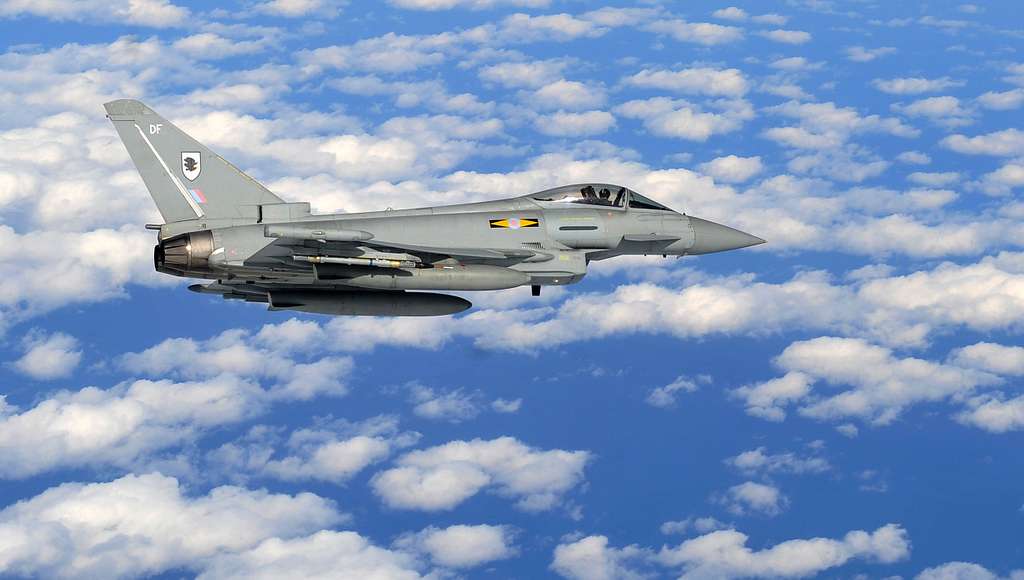
Austria’s government said its Eurofighter Typhoon jets were deployed on two consecutive days to intercept U.S. military aircraft approaching or traveling through Austrian airspace.
The incidents occurred on May 10 and 11 and involved modified PC-12 turboprop planes, known in U.S. military service as the U-28. These aircraft are mainly used for reconnaissance and signals intelligence missions.
Initial reports in German-language media suggested that Austrian airspace had been violated without authorization. However, Austrian military spokesperson Michael Bauer later clarified on X that no unlawful entry had apparently taken place. According to Bauer, the U.S. Air Force had originally obtained clearance for two aircraft to cross Austrian airspace on May 10 but ultimately did not use that authorization. Later the same day, two other U.S. aircraft approached Austrian territory without prior notice, prompting Austria to scramble fighter jets. The aircraft turned away before entering Austrian airspace.
For May 11, the United States reapplied for overflight permission and proceeded with the approved transit. Austrian fighters were again dispatched to visually verify that the aircraft matched those listed in the authorization request. Bauer remarked on X that “some things you have to see for yourself.”
He also stated that the May 11 mission was classified as a “priority A intercept,” the Austrian Air Force’s highest level of urgency.
Subsequent reporting by the Austrian newspaper Der Standard indicated that Austrian authorities were still examining whether the aircraft that crossed Austrian airspace were indeed the same ones covered by the approved permit. Officials did not explain why the verification process was taking additional time.
Austria, which maintains constitutional neutrality and is not part of NATO, requires foreign military aircraft and troop movements to receive prior authorization. Such approvals are generally granted only when operations are not connected to active conflicts. Austria recently became the fifth European country to restrict airspace access for U.S. operations connected to the conflict involving Iran. Austrian Vice Chancellor Andreas Babler stated that Austrians wanted “nothing to do with Trump’s politics of chaos and his war.”
Reports said the May 11 interception happened above the Totes Gebirge in Upper Austria, more than 60 kilometers from Germany’s border, where the American aircraft were intercepted by Eurofighter Typhoons.
Swiss outlet 20 Minuten first covered the incident, and several German-language media organizations later confirmed it. Early reports alleging unauthorized entry into Austrian airspace were later rejected by the Austrian military.
A spokesperson for United States European Command told Defense News that the flight proceeded after officials corrected an administrative issue in the overflight approval paperwork. The spokesperson added that the United States continues to coordinate closely with Austrian authorities and complies fully with Austrian regulations governing military overflights.
Unauthorized U.S. military flights through European neutral states are uncommon, as approvals are typically granted during peacetime. Austria’s geographic position between Germany and Italy makes it an important transit corridor between northern and southern Europe. Neighboring Switzerland follows similar neutrality principles.
One notable earlier incident occurred in October 2002, when the United States allegedly attempted to move two F-117A Nighthawk stealth aircraft through Austrian airspace while filing paperwork only for their accompanying KC-10A tanker planes. Austrian Saab 35 Draken jets detected the undeclared aircraft, leading Vienna to issue a formal diplomatic protest.
Bauer said the latest incidents will also be handled through diplomatic discussions.