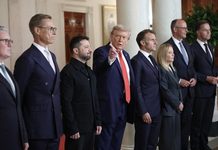
Ukrainian, European, and U.S. representatives concluded two days of discussions in Berlin, which officials say produced the clearest progress so far toward outlining a political roadmap to end Russia’s full-scale war against Ukraine, even though fundamental disputes over territory remain unresolved.
At the same time, Ukrainian officials announced on Tuesday that the country’s projected defense spending for 2026 will reach $120 billion, with international partners expected to provide half of that amount.
President Volodymyr Zelenskyy and other Ukrainian officials said the Berlin talks centered on a set of five documents designed to serve as the foundation for a future peace agreement. Several of these texts focus on long-term security guarantees for Ukraine. Kyiv has indicated that some elements are intended to carry legal force, including a mutual defense clause comparable to NATO’s Article 5, which would require approval from the U.S. Congress and be reinforced by additional commitments from European nations.
German officials characterized Washington’s proposed legal and military assurances as exceptional, calling them a significant breakthrough. The Berlin meeting also marked the first major European Union–led effort to influence the security framework surrounding a potential ceasefire.
German Defense Minister Boris Pistorius said on Tuesday that Europe, the United States, and Ukraine had developed a shared understanding in their efforts to end the conflict. He noted that this alignment follows earlier disagreements between Washington and European capitals over a U.S.-backed peace initiative that many in Europe viewed as overly accommodating to Moscow’s objectives.
In recent months, Europe has taken on a more central role, now shouldering the bulk of financial support for Ukraine’s defense after the United States halted military aid in March 2025. Data from the Kiel Institute shows that European assistance since the start of the invasion now exceeds total U.S. support by more than double.
Despite advancements on security assurances, negotiators reported no meaningful movement on territorial issues. Russia’s insistence on international recognition of its control over parts of eastern Ukraine remains fundamentally at odds with Kyiv’s position. German officials cautioned that resolving these matters would be a prolonged and difficult process.
Ukrainian leaders have consistently rejected any proposal involving the surrender of Ukrainian-held land, emphasizing that no agreement should lock in advantages for Russia by freezing the conflict. European officials have reiterated that decisions on territory must be made by Ukraine alone, despite recent pressure from Washington urging Kyiv to relinquish roughly 20% of its territory.
Zelenskyy has indicated that once the five-document framework is finalized with U.S. and European partners, Ukraine anticipates a direct meeting with President Donald Trump to assess whether Moscow would accept the proposed structure.
Both European and American officials described the Berlin discussions as highly constructive, stressing that consensus was reached on several major points, even though the talks did not result in a formal ceasefire proposal.
A European-led multinational peacekeeping force, to be deployed in Ukraine after the conflict ends, is a central component of the proposed plan. UK Defence Secretary John Healey reaffirmed Britain’s support for such a mission, stating that the UK continues to invest in preparing its forces for deployment, including ground troops and air assets, once peace is achieved.
Following the talks, ten European leaders and European Commission President Ursula von der Leyen released a joint statement advocating the creation of a Europe-led multinational force for Ukraine, supported by the United States. The proposal also called for continued and substantial assistance to help Ukraine maintain a peacetime military strength of approximately 800,000 personnel.
Until then, Ukraine will remain dependent on Western backing. Addressing the Ukraine Defense Contact Group on Tuesday, Defense Minister Denys Shmyhal said the country expects war-related costs to reach $120 billion in 2026, with Ukraine able to finance only half independently.
“The remaining $60 billion must be provided by our partners,” Shmyhal said, urging participating nations to dedicate at least 0.25% of their 2026 economic output to Ukraine’s defense. He emphasized that strengthening air defense capabilities remains a top priority.
“Decisive and unified action will speed our progress toward a fair and lasting peace,” Shmyhal said. “This is the time to move forward.”