Amid the snowy, muddy woodlands of eastern Estonia, NATO and Russia face each other with steady, tense vigilance. This frontier — separating a nation smaller in population than Vienna from the world’s largest nuclear power — is where many experts believe Russian President Vladimir Putin could one day attempt a limited strike against the alliance.
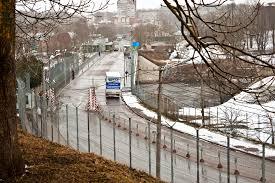
The atmosphere along the border is heavy and quiet. Beyond the tall barbed-wire fence lies a controlled “border regime area,” watched over by special police units and scattered with guard towers. Only a handful of villages exist within this zone, many inhabited by Russian speakers, connected by empty yet perfectly maintained roads.
Until recently, this border hosted a peculiar reminder of how closely the people on both sides had once been linked. Estonian Road 178, a relic of Soviet planning, briefly crosses into Russian territory in two places before reconnecting with Estonia, allowing several small towns to reach the regional hub of Värska. For years, a low-profile understanding between local border guards allowed residents to drive through these short Russian segments without checks, as long as they stayed inside their cars and didn’t stop.
That informal arrangement abruptly ended on October 10.
“We suddenly saw a larger group of soldiers. Most of them were equipped like regular troops, not border guards,” said Renet Merdikes, the Border Police captain responsible for this section, known as the Saatse Kordon. With 13 years of experience along the frontier, he was struck by their presence.
Eleven Russian personnel were spotted wandering around the “Saatse Boot” — a wedge of Russian land jutting into Estonia through which Road 178 cuts. They were even standing on the asphalt while Estonian vehicles still passed through between the villages of Sesniki and Lutepää.
Estonian officials swiftly closed the road. It has remained shut ever since.
“We didn’t want to wait for something serious to happen,” Merdikes said. “We can’t act on Russian territory, and we can’t guarantee our citizens’ safety there.”
The Russian soldiers eventually departed without incident. When Estonian officers contacted their Russian counterparts through a hotline intended to prevent border flare-ups, they were told the activity was “routine.”
Soon after, temporary roadblocks gave way to a permanent fence, and Estonia accelerated work on replacement routes that bypass Russian land entirely.
For decades, the border itself had been little more than a geographic formality, especially during the Soviet era when Estonia and Russia were part of the same state. Long after independence, personal and practical cross-border ties persisted. Even Estonian border officers once used the shortcut through Russia — a practice now stopped due to security concerns.
Despite centuries of Russian rule under both the empire and the Soviet Union, Estonia’s cultural identity has remained distinctly European. Tallinn proudly highlights its historical connections to the Hanseatic League, and the Estonian language carries influences from Finnish and German. Soviet symbols have largely vanished from public spaces, replaced by narratives emphasizing the occupation period.
Yet real-world connections don’t vanish overnight. In Narva — Estonia’s largest border city — a steady stream of pedestrians still crosses the bridge into Ivangorod, its Russian twin city. The crossing has been closed to vehicles since 2022 but remains busy with foot traffic. The bridge itself is fortified with tank traps, electronic gates, and layers of razor wire. A nearby rail bridge stands mostly quiet; Estonia halted cross-border rail services on January 1, 2023.
Just south of Narva, a dam fortified with guard towers, cameras, and razor wire makes clear that no crossing is permitted. Still, people gather there to catch a Russian phone signal, a reminder of how intertwined life once was.
But these connections are fading. Many border points are now shut indefinitely, economic links have been crippled by sanctions, and Estonia is pouring resources into reinforcing the frontier.
“We’re building and upgrading our border continuously,” said Merdikes. A modern fence already covers much of the land boundary, and in the Saatse region, Estonia is installing a continuous chain of cameras to monitor every meter.
Beyond the fence, the Baltic states are constructing the “Baltic Defense Line,” a joint project announced in early 2024 to deter or slow a potential Russian attack. The line will feature anti-tank barriers, dragon’s teeth, layers of barbed wire, bunkers, and areas prepared for landmines if needed. Estonia plans to erect 600 bunkers alone, with Latvia and Lithuania following suit. The effort, coordinated closely with NATO, is expected to cost Estonia about €60 million and finish in 2027.
“The war in Ukraine has shown how difficult and costly it is to retake occupied territory,” the Estonian Defense Investments Center noted in its project summary. “We have to prepare now.”
In towns like Sillamäe, the Soviet past still lingers. The former secret city, once home to a major uranium enrichment facility, now wears signs marking its public bomb shelters — symbols that began appearing after Russia’s 2022 invasion of Ukraine. Many residents here speak Russian daily, including long-time inhabitants like Larisa, who arrived in 1985 and holds both Estonian and Ukrainian passports. To her, the nearby border feels distant and irrelevant.
Yet analysts warn the region is not immune to future provocations. Narva, with its predominantly Russian-speaking population, is often cited as a potential target for a limited Russian incursion meant to test NATO’s resolve — similar to Crimea in 2014. Germany’s intelligence chief, Bruno Kahl, has openly suggested that such a scenario cannot be ruled out.
Estonians, however, insist they are prepared.
The threat may not be imminent, or it may emerge elsewhere along NATO’s long boundary with Russia, but tension at the Estonian border is unlikely to fade. New barriers will rise, bunkers will be buried, and cross-border relationships will continue to strain.
Still, for those who patrol the frontier every day, the mission remains steady.
“Some things don’t change overnight,” Merdikes said. “The border may be calm, but we have to stay alert and watch for anything that could signal a shift.”