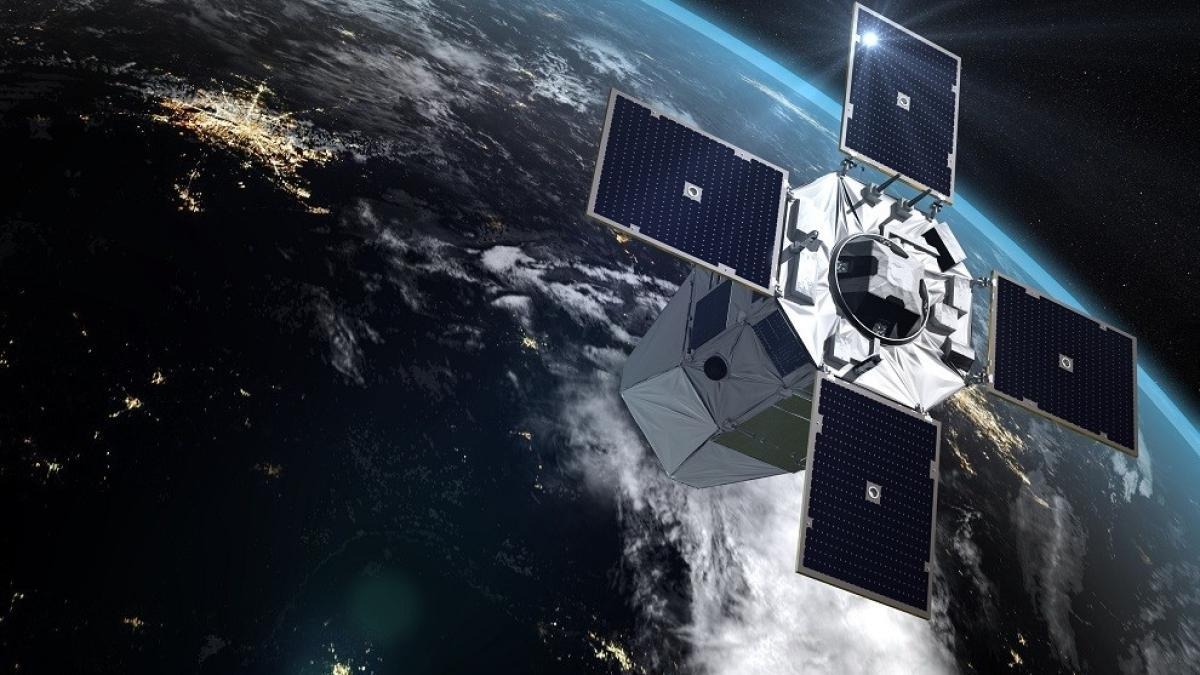
France has ordered two next-generation IRIS military satellites from Airbus Defence and Space and Thales Alenia Space under a contract valued at more than €1.5 billion. The programme will replace the country’s existing CSO (Composante Spatiale Optique) constellation and preserve its sovereign space-based imagery intelligence capabilities beyond 2035.
The new satellites are expected to deliver substantial improvements in image quality and the speed at which intelligence imagery becomes available to military users. According to France’s Directorate General of Armament (DGA), the system will provide extremely high-resolution images, both day and night, across visible and infrared wavelengths, with global coverage.
The order forms part of France’s efforts to maintain its independent military intelligence infrastructure as European defence requirements and the strategic environment continue to evolve.
France’s IRIS Satellites to Strengthen Military Intelligence
France is among the relatively small number of European NATO members operating a sovereign constellation of high-end optical military observation satellites. Many of its allies continue to depend on lower-resolution space-based assets or intelligence provided by the United States.
The importance of this capability has become particularly evident during the war in Ukraine. French President Emmanuel Macron said in January that France was providing two-thirds of the intelligence capabilities being supplied to Ukraine.
The DGA described the IRIS programme as essential to maintaining this capability while improving operational performance.
“The IRIS program aims to ensure the continuity of this capability while improving performance to meet the needs of the forces in a rapidly evolving strategic environment,” the agency said.
The new constellation is expected to improve not only the quality of satellite imagery but also the speed with which information can be collected, processed and delivered to operational users.
Airbus and Thales Alenia Space Share the €1.5 Billion Contract
The contract, valued at more than €1.5 billion for the entire industrial consortium, was awarded to Airbus Defence and Space and Thales Alenia Space.
The two companies will divide responsibilities across satellite platforms, imaging payloads and ground infrastructure.
Airbus will supply the satellite platforms, provide a significant share of the payload for the first satellite and take responsibility for the ground segment. Thales Alenia Space will develop the second satellite’s payload, supply critical components for the first and contribute to the ground infrastructure.
The programme also involves several specialist subcontractors. According to the DGA, these include Lynred, Pyxalis, Sodern, Safran Reosc and Air Liquide Advanced Technologies.
The DGA notified Airbus Defence and Space and Thales Alenia Space of the order on November 5.
Advanced Imaging Technology and AI-Based Processing
The IRIS system will incorporate several advanced technologies designed to improve image acquisition and processing.
According to Thales, the programme will feature a hyper-stable telescope equipped with active optics, ultra-sensitive high-speed digital sensors and artificial intelligence-based image processing.
These technologies are intended to improve the quality of collected imagery and accelerate the conversion of raw satellite observations into useful intelligence.
Thales Alenia Space CEO Hervé Derrey described the imaging equipment as “the most advanced optical instrument ever built in Europe.”
The programme is therefore not simply a replacement of existing satellites. It is also intended to introduce a new generation of European optical observation technology for military intelligence applications.
IRIS Satellites to Replace France’s Existing CSO Constellation
The IRIS programme will succeed France’s existing CSO satellite system, which consists of three spacecraft launched in 2018, 2020 and 2025.
The first IRIS satellite is scheduled to become operational in 2033. Both new satellites are expected to be in orbit around 2035.
According to Thales, the first IRIS satellite will replace CSO-1 and CSO-2, helping maintain continuity in France’s space-based imagery intelligence capabilities.
Following the end of the operational life of the final CSO satellite, the second IRIS spacecraft is expected to provide a significant improvement in image-resolution performance.
This phased transition is intended to prevent a gap in France’s access to high-resolution optical intelligence from space.
France Leaves the Door Open to International Cooperation
The new satellite system will be operated by the Space Command within the French Air and Space Force.
Although IRIS is being developed primarily to preserve France’s sovereign military intelligence capabilities, the programme is not necessarily restricted to French users.
The DGA has described the initiative as “resolutely open to cooperation”, allowing partner countries to access the system.
This approach could provide opportunities for closer intelligence cooperation among European and other allied countries, while strengthening France’s position as a provider of independent space-based military intelligence.
With the first satellite expected to enter service in 2033 and the full constellation planned for around 2035, IRIS represents a major investment in France’s long-term military space infrastructure. Its introduction will help maintain the country’s independent access to high-resolution intelligence imagery while bringing new capabilities to its armed forces and potentially its international partners.