France’s Bastille Day celebrations on July 14 will carry a notably assertive message this year under the theme “Europe’s Strategic Awakening.”
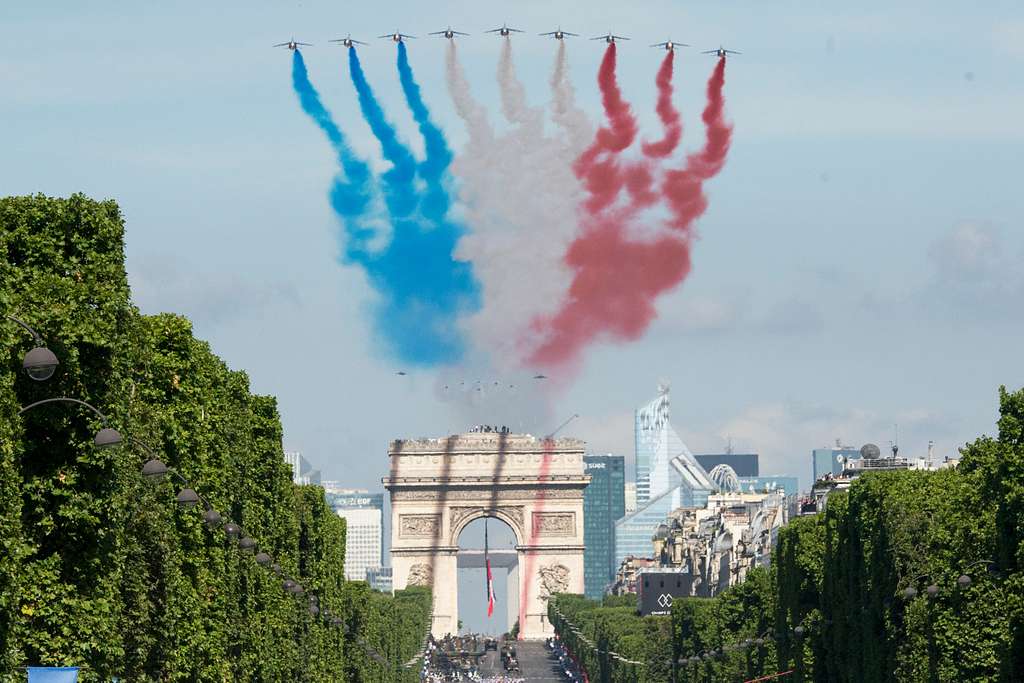
One of the most prominent demonstrations of this theme will be the traditional aerial parade, which is expected to feature 98 fixed-wing aircraft—significantly more than the 65 aircraft that participated in 2025. European alliances will take center stage in the display, both symbolically and literally.
According to the latest plans, the flyover will open with nine Alphajet trainers from the Patrouille de France, accompanied by two Ukrainian Mirage 2000B fighter aircraft. They will be followed by a formation led by two French Rafale fighters, including one operated by France’s strategic nuclear forces, the Forces Aériennes Stratégiques. Accompanying the French aircraft will be fighter jets representing four of France’s key European partners: Germany, Greece, the United Kingdom and Sweden.
Earlier planning documents suggested that Germany would contribute a Eurofighter, Sweden a Gripen, the United Kingdom an F-35, and Greece an F-4 Phantom. However, the latest official program no longer identifies the specific aircraft models participating.
The composition of this formation carries considerable strategic symbolism. Each of the four participating countries has, in some form, aligned itself with France’s proposed expanded nuclear deterrence framework. French President Emmanuel Macron unveiled this initiative in March during a high-profile address delivered aboard a French nuclear submarine.
The proposal aims to extend France’s nuclear protection umbrella across Europe and has been widely interpreted as a response to what many perceive as a gradual reduction of U.S. strategic engagement on the continent. At the same time, it represents either a challenge to or an alternative framework alongside the longstanding American-led nuclear deterrence architecture in Europe.
Although the United Kingdom maintains its own independent nuclear arsenal and has not formally joined France’s forward deterrence initiative, London and Paris have nonetheless strengthened their nuclear cooperation considerably. While both nations continue to maintain separate deterrent capabilities, they now coordinate aspects of their strategic posture under the Northwood Declaration signed in 2025.
A notable feature of this year’s Bastille Day flyover is the absence of any American military aircraft. During President Donald Trump’s first term in office, the 2017 celebrations featured U.S. Air Force Thunderbirds flying F-16s accompanied by F-22 Raptors, with Trump and Macron observing the display together.
In contrast, the 2026 celebrations will focus exclusively on Europe. Beyond the event’s assertive theme, every invited nation will be European. Alongside the fighter aircraft, the aerial parade will also include two German C-130 Hercules transport aircraft and one Airbus A400M Atlas each from Germany and the United Kingdom during the latter stages of the procession.
An earlier version of the program, which was later removed from the French Ministry of Defense website, had also listed a Danish F-35, a Polish F-16 Fighting Falcon and a Spanish F-18 Hornet among the participating aircraft accompanying the French Rafales near the beginning of the flyover. These aircraft were subsequently omitted without any official explanation.
European participation in France’s national day celebrations is not unprecedented. During last year’s Bastille Day events, fighter aircraft from Switzerland, Belgium, Germany, Italy, Spain and the United Kingdom flew alongside French aircraft.
However, the symbolism has evolved significantly. In 2025, the multinational aircraft primarily followed two French Mirage fighters in a formation designated for air defense operations. This year, by contrast, European aircraft will fly alongside a nuclear-capable French Rafale in a formation titled “Entrée En Premier: Intervention,” or “First-Entry Strike Operations,” underscoring a far more assertive and forward-looking strategic posture.