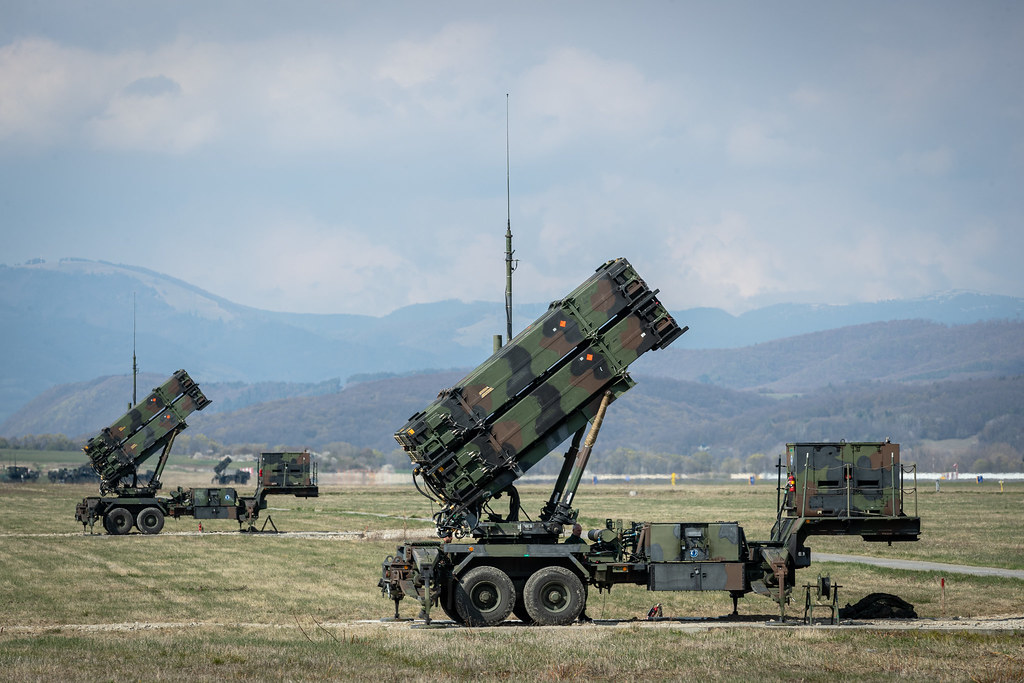
At the Group of Seven summit in France, U.S. President Donald Trump reportedly informed Ukrainian President Volodymyr Zelenskyy that Washington was open to considering a proposal that would allow Ukraine to manufacture its own Patriot interceptor missiles. This marks the first indication from the United States that it may support a request Kyiv has pursued since Russia launched its full-scale invasion in 2022.
Weeks before Trump’s remarks, Ukrainian officials had already suggested that Kyiv’s growing network of defense partnerships was strengthening its position internationally. Speaking with Defense News in Kyiv earlier this month, Kyrylo Budanov, head of the Office of the President of Ukraine and the country’s former military intelligence chief, argued that Ukraine was no longer approaching negotiations solely as a recipient of assistance.
“Ukraine is not a country that only asks for support,” Budanov said. “We are partners prepared to offer capabilities and opportunities that are valuable. We are willing to contribute what genuinely interests the United States.”
For much of the conflict, Ukraine has depended heavily on Western military aid to sustain its defense efforts. However, that dynamic is beginning to evolve as American officials increasingly recognize the value of Ukrainian-developed interceptor drone technology, particularly as U.S. air defense systems face growing demands following the conflict involving Iran.
Zelenskyy stated on Tuesday that, for the first time, American officials appeared receptive to discussions about granting production licenses for Ukrainian missile manufacturing, describing the topic as part of his conversations with Trump in Évian.
Just two days later, Ukraine’s defense minister signed an agreement in Brussels with Germany to cooperate on the development of anti-ballistic missile defense systems. The agreement represented the second major defense-production partnership Ukraine had secured with a key Western ally within a single week.
Meanwhile, discussions surrounding a potential ceasefire continue to gain attention, with September emerging as a possible target date for renewed negotiations. Zelenskyy has previously characterized this period as a critical window for meaningful diplomatic progress, which has largely stalled since February. According to Budanov, Ukraine intends to enter any future negotiations with tangible bargaining assets rather than simply presenting a list of requests.
Not everyone agrees that Ukraine’s negotiating position has strengthened significantly. In March, Trump stated that the United States did not require Ukrainian assistance in the field of drone defense technologies.
“We know more about drones than anybody,” Trump told Fox News while responding to Kyiv’s offer to share its expertise in counter-drone systems.
Russian President Vladimir Putin, meanwhile, declared during Victory Day celebrations last month that the conflict was approaching its conclusion and maintained that Russia’s victory was inevitable.
Budanov dismissed those comments, describing them as a familiar form of information warfare. According to him, Putin consistently projects confidence regardless of Russia’s actual circumstances.
Budanov has also rejected portrayals of Ukraine as a passive recipient of foreign assistance. Responding to questions about the potential conclusion of the conflict’s active phase, he criticized suggestions that Ukraine’s future depends entirely on decisions made by its allies.
“We should stop minimizing our own role by acting as though everything depends on what others choose to provide us,” he said.
In Budanov’s view, Ukraine’s leverage stems from Russia’s increasingly limited options. He argued that Moscow has recognized it cannot achieve victory through military means alone, leaving negotiations as its most practical path forward.
Ukraine sought to reinforce that argument last week by carrying out its largest drone operation against Moscow to date. Ukrainian forces struck the Russian capital’s primary oil refinery twice within a single week as part of an expanding campaign targeting Russian energy infrastructure. Budanov indicated that these operations were intended, in part, to increase pressure on the Kremlin to engage in negotiations.
He further argued that both Moscow and Washington understand that broader economic relations cannot fully normalize without first addressing the conflict in Ukraine.
On the battlefield, Ukraine’s air defense capabilities continue to improve rapidly. According to Ukraine’s Defense Ministry, air defense forces intercepted approximately 92% of the Shahed drones and other attack drones launched by Russia in May, a significant increase from the 80% interception rate reported in December 2024.
When missile interceptions are included, Ukraine’s General Staff estimated that overall interception rates exceeded 88% during May. Similar performance levels have reportedly continued into June. For example, Ukrainian forces intercepted 92% of a large-scale Russian attack involving 272 drones on June 6.
Interceptor drones have become an increasingly important component of Ukraine’s defensive strategy. According to Defense Minister Mykhailo Fedorov, the proportion of downed Shahed drones attributed to interceptor systems has doubled over the past four months. Ukraine manufactured approximately 100,000 interceptor drones during 2025, and Fedorov stated that production during the first four months of 2026 alone surpassed that figure.
Despite growing cooperation, the agreement intended to formalize broader defense exchanges between the United States and Ukraine remains unsigned. A draft memorandum prepared jointly by the U.S. State Department and Ukrainian Ambassador Olha Stefanishyna was completed in May, but according to CBS News, it has yet to receive Trump’s approval because of insufficient support among senior Pentagon and White House officials.
Budanov argued that the conflict involving Iran significantly altered the strategic landscape. He suggested that developments in the Middle East allowed Washington to refocus attention on Ukraine while simultaneously highlighting critical gaps in U.S. air defense capabilities that Ukraine could help address.
According to a Center for Strategic and International Studies analysis published in April, the United States launched between 1,060 and 1,430 Patriot interceptor missiles during operations related to the Iran conflict. With each interceptor costing roughly $3.9 million, that total exceeds the approximately 600 Patriot missiles Ukraine has received from all Western allies combined over four years of war.
Ukraine hopes to manufacture these missiles domestically. However, U.S. production facilities currently produce only about 60 to 65 Patriot interceptors per month. Zelenskyy recently told CBS News that such production levels are inadequate for current global security demands and argued that licensing production among allied countries represents the most effective way to increase output.
In return, Ukraine offers extensive experience in another critical area of air defense. Its interceptor drones, developed specifically to destroy low-cost Shahed drones that frequently target Ukrainian cities, cost between $1,000 and $2,500 per unit. According to Fedorov, new technologies have automated approximately 95% of the interception process.
After spending more than four years relying heavily on foreign military assistance, Ukraine is now intensifying operations against Russian targets while seeking to leverage its military capabilities to strengthen its diplomatic position. Kyiv’s strategy appears to be based on increasing pressure on Moscow in hopes of bringing Russia back to meaningful negotiations before the anticipated September window closes.
“Military victory is no longer a viable path for them, and they understand that,” Budanov said regarding Russia. “That leaves negotiation as the only realistic option.”