A post published by India’s Ministry of Defence (MoD) on social media stated that the project would contain more than 68% indigenous content. Although the accompanying press release did not disclose further technical information, a photograph from the contract-signing ceremony indicated that the agreement covers two Veer-class vessels and two Ranvir-class ships.
Modernisation of the Rajput/Ranvir Class
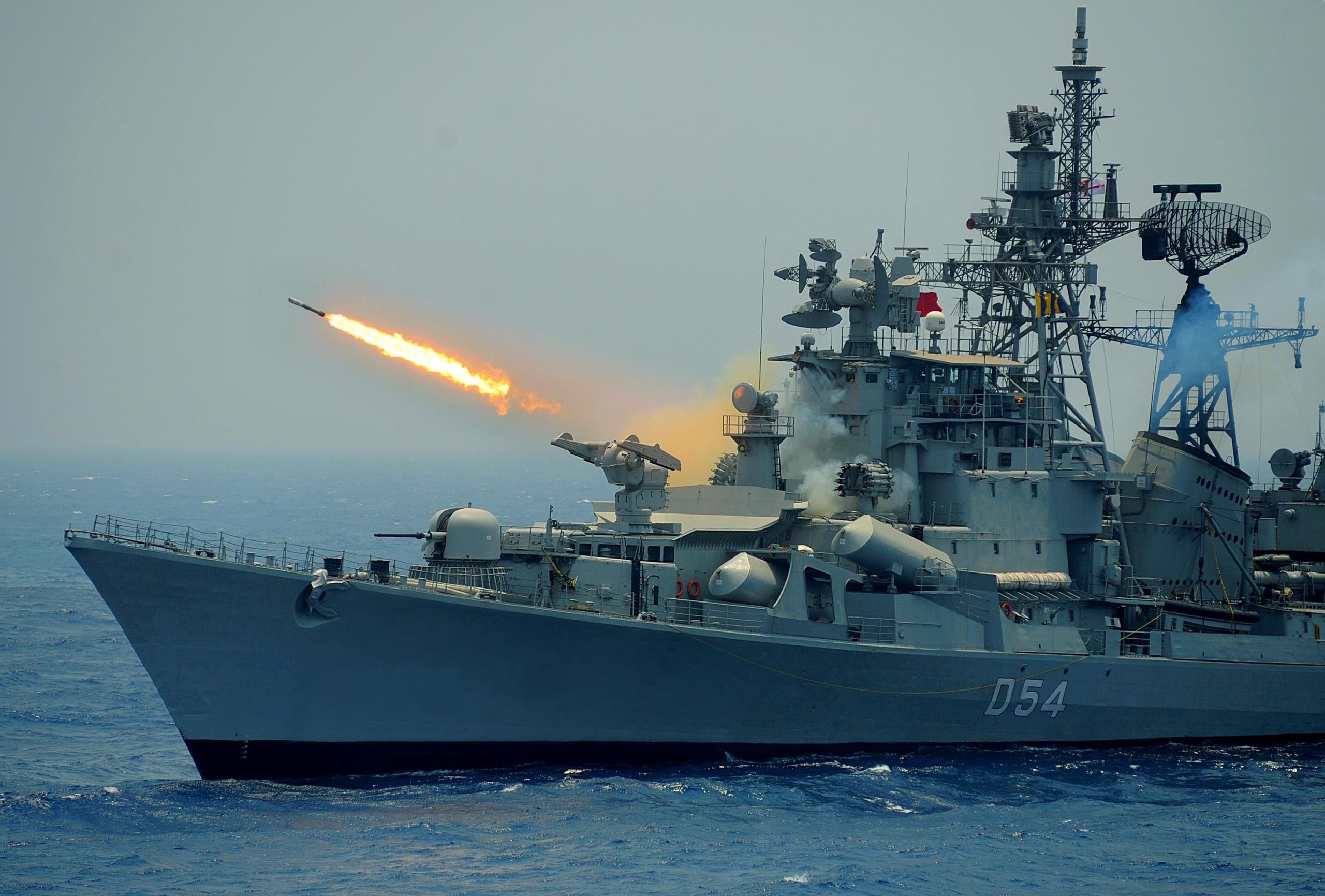
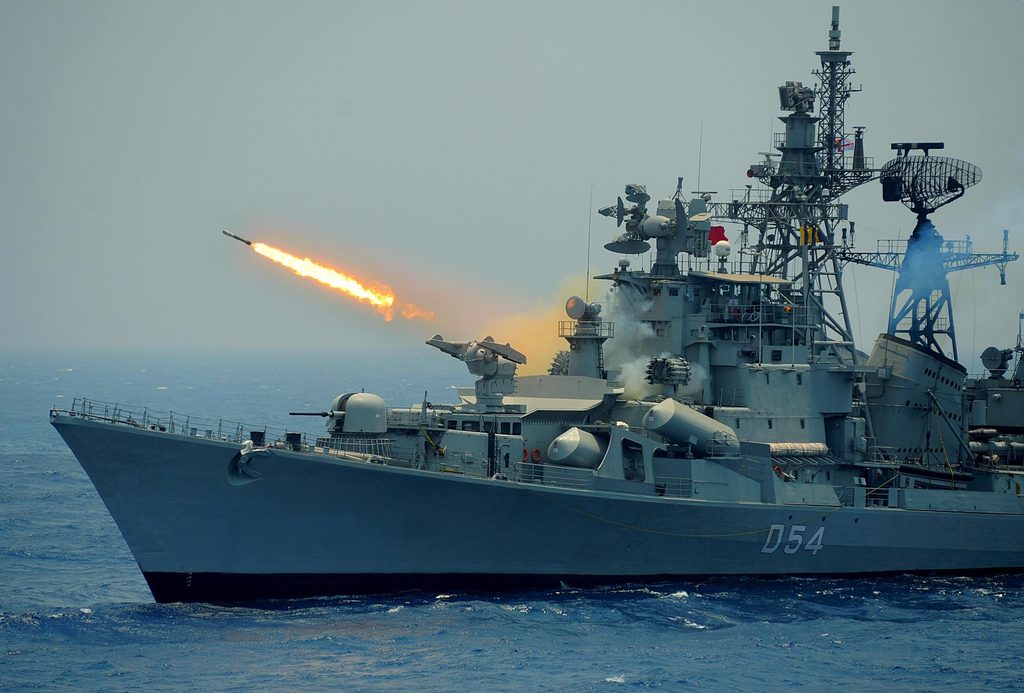
India acquired five Soviet-built Kashin-class destroyers, known domestically as the Rajput class, which entered Indian Navy service between 1980 and 1987. Three ships from the class remain operational: INS Rana, commissioned in 1982; INS Ranvir, commissioned in 1986; and INS Ranvijay, commissioned in 1987.
INS Ranvir and INS Ranvijay were among the first Indian Navy ships to receive the BrahMos supersonic cruise missile. Both vessels carry an eight-cell vertical launch system (VLS) at the stern. However, their original inclined launchers for four Styx anti-ship missiles remain installed at the bow.
INS Rana previously carried four Styx missiles in inclined launchers, but these were removed during a visit to Sri Lanka in 2025. In recent years, the ship has also served as a test platform for the Defence Research and Development Organisation’s (DRDO) vertically launched short-range surface-to-air missile system, VLSRSAM. An eight-cell launcher was installed at the stern, in the position occupied by the BrahMos launchers on its sister ships. The vessel is also equipped with the associated multi-function radar manufactured by Bharat Electronics Limited (BEL).
The latest contract specifies two ships from the class and is expected to focus on inclined launchers. Considering INS Rana’s age and its specialised role in VLSRSAM testing, INS Ranvir and INS Ranvijay appear to be the most likely candidates for new BrahMos launchers.
INS Rajput previously carried four twin-cell inclined launchers, providing capacity for eight BrahMos missiles. If the same arrangement is adopted on the two ships, each could carry 16 missiles when the inclined launchers are combined with the existing eight-cell VLS. This would bring their potential missile capacity in line with that of the newer Kolkata- and Visakhapatnam-class destroyers.
BrahMos Integration on Veer-Class Corvettes
The Veer class, developed from the Soviet Tarantul-class design under Project 1241 RE, is an Indian variant of a small missile corvette. The Indian Navy initially imported five vessels weighing less than 500 tonnes between 1987 and 1990. Mazagon Dock Shipbuilders and Goa Shipyard subsequently constructed eight additional ships under licence, with deliveries taking place between 1990 and 2002. Seven of the domestically built vessels, which use combined gas turbine and gas turbine (COGAG) propulsion, remain in service.
One of these ships, INS Vidyut, was observed carrying two twin-tube inclined BrahMos launchers during Navy Day events in December 2025. The launchers had reportedly been transferred from the decommissioned INS Rajput. Commissioned in 1995, INS Vidyut is among the older vessels in the group.
INS Vipul, which sailed alongside INS Vidyut during the December 2025 events, was still equipped with Styx missiles. INS Rajput had originally carried four twin-tube BrahMos launchers, two of which were reportedly transferred to INS Vidyut. This raises the possibility that INS Nashak, commissioned in 1994, could receive the remaining pair.
The two newest Veer-class vessels are INS Prabal and INS Pralaya, both commissioned in 2002. They are the only ships in the class equipped with 16 Kh-35E anti-ship missiles arranged in four quadruple launchers. These two corvettes are potential recipients of the fire-control system (FCS) and launchers covered by the new agreement.
Given the BrahMos missile’s substantial dimensions and the limited space available aboard these small corvettes, their eventual configuration may be restricted to four missiles. A similar four-missile arrangement is expected on the six Next Generation Missile Corvettes (NGMV) currently being built for the Indian Navy.
The addition of BrahMos would give the Indian Navy several Veer-class corvettes capable of carrying a missile weighing approximately three tonnes, making them among the smallest vessels to operate this weapon. The system can engage both land-based and maritime targets at extended ranges, delivering them at supersonic speeds with high accuracy.
The Navy has already incorporated BrahMos into the modernisation programmes of older vessels, including ships of the Delhi class. Nevertheless, upgrading the Veer and Ranvir classes is notable because both designs are approaching the later stages of their service lives.
BrahMos Gains Ground in Export Markets
BrahMos has also attracted growing interest from Southeast Asian countries. India has a concluded contract worth approximately $370 million with the Philippines, while agreements involving Vietnam and Indonesia were reported in 2026.
The reported deal with Vietnam is valued at around $630 million, while Indonesia’s agreement has been estimated at between $450 million and $630 million. Additional purchases by these countries are considered possible, potentially expanding the missile system’s regional presence.
Additional Order for Varunastra Heavyweight Torpedoes
In a separate development, the Ministry of Defence signed a contract with Bharat Dynamics Limited on 15 October for the supply of Varunastra ship-launched heavyweight anti-submarine torpedoes. The agreement is valued at ₹1,543 crore, equivalent to approximately $160 million.
The new procurement follows an earlier order placed in July 2016 for 73 torpedoes. The latest contract is expected to cover roughly 40 additional units, although the precise quantity was not specified in the supplied information.
DRDO has also developed newer electric heavyweight torpedoes (EHWTs) for submarine operations. These weapons are intended for integration with the Indian Navy’s Kalvari-class submarines, based on the French Scorpène design.