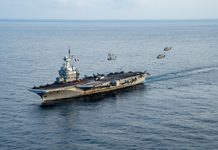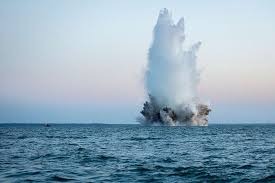
The above image depicts a ship hit by a naval mine.
The Italian Ministry of Defense, through its Naval Armaments Directorate (NAVARM), has launched a preliminary market consultation for the acquisition of a containerized naval mine-laying system designed to handle operational and training munitions.
This system is intended for deployment across the Italian Navy’s latest vessels that are equipped to host containerized solutions on their aft decks. These platforms include next-generation mine countermeasure vessels (CNG-C MCMVs), multi-purpose coastal units (MTC/MTF), a pre-owned offshore support vessel (OSV), the Olterra special operations and submarine rescue ship (SDO-SuRS), the Quirinale hydro-oceanographic platform, and future multi-purpose ships dedicated to underwater surveillance (UPSDS).
The planned acquisition will provide mine-laying capabilities to both newly constructed and recently procured naval platforms. According to official documentation, the system is expected to enhance safety during the storage and transportation of mines—from ammunition depots to ships—while also improving consistency in deployment procedures across different vessel types.
The proposed solution must consist of two standard 20-foot ISO container modules. The first module will serve as both a transport unit and mine-launching system. It must comply with NATO military standards such as MIL-STD-810F and MIL-STD-461F, and meet certification requirements including CSC and DNV 2.7-1. It must also be approved for the transport of Class 1 explosives in accordance with European ADR and international IMDG regulations. This module should be capable of deploying MP-80, Manta, Murena, and Asteria naval mines, as well as supporting all standard operational processes involved in mine-laying.
The second module will function as a storage unit, with a minimum capacity of 12 mines of types MP-80, Murena, or Asteria, or up to 24 Manta mines, or a combination of these.
In addition, the system must incorporate a Planning and Evaluation (P&E) component to support mission preparation, execution, and analysis. This system should include digital mapping capabilities for minefields, calculation of actual versus planned deployment positions, tracking deviations, countdown visualization for each mine release, recording of operational data, and export functionality in AML format (STANAG 7170) and NATO ADatP-3/APP-11 formats.
The system must be compatible with standard twist-lock mechanisms for secure deck installation. All necessary onboard support—such as power supply—must be provided by the host vessels. Containers are required to be positioned longitudinally at the stern to facilitate efficient mine deployment. For the new CNG-C MCMVs specifically, only the launcher module will be required.
Furthermore, the system must demonstrate high levels of reliability, redundancy, and ease of maintenance. A ten-year maintenance plan is required, to be executed by Italian Navy personnel, along with a five-year logistics and support package for in-service operations.
The supplier will also be responsible for delivering training programs for both operators and maintenance personnel, conducted at sea and on land. Final system acceptance will depend on successful completion of sea trials במסגרת an Operational Experimentation (OPEX) campaign.
Participating companies must prove they have an agreement with the mine design authority, RWM Italia (based in Ghedi, near Brescia), for configuring fire-program loading systems for MP-80, Murena, and Asteria mines, or setting systems for Manta mines. They must also hold—or be able to obtain—the necessary licenses. If required by NAVARM, bidders must be willing to conduct validation tests at their own expense to verify their capabilities.
The estimated contract value is €8 million (excluding VAT), with a projected duration of 730 days. Compliance with the REACH Regulation and other contractual requirements is mandatory. Interested companies are required to submit their responses within 21 days of the notice’s publication.