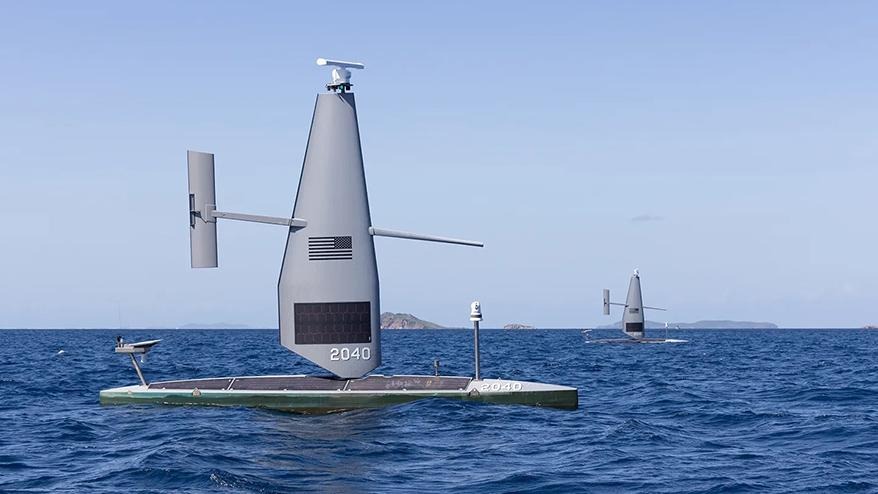
U.S.-based Saildrone has registered its first four Voyager unmanned surface vehicles (USVs) under the Danish flag, marking the first occasion on which the company’s vessels have operated under a national maritime registry.
The move comes as Saildrone expands its European production network, working with partners in the Netherlands, Norway and Poland to increase manufacturing capacity for customers across the region, including military organizations.
Kim Løye Sørensen, European head of business development for Saildrone Denmark, the company’s European subsidiary, told Defense News that demand for unmanned surface systems is increasing across Europe. The company is currently in discussions with several European navies about potential deployments.
Sørensen said Saildrone previously worked with the Danish Navy, operating four Voyager platforms for a six-month period. He added that the Danish government and Navy are now developing a new agreement that could bring additional Saildrone systems into service with the Danish Armed Forces. The company also expects its unmanned vessels to operate in other northern European countries in the near future.
Denmark occupies a strategically important position between the Baltic and North seas. The Royal Danish Navy therefore has an important role in monitoring and protecting maritime activity around the Danish Straits, which provide a key passage between the two bodies of water.
Voyager Designed for Long-Endurance Maritime Missions
Saildrone’s 33-foot Voyager is designed for coastal surveillance and nearshore mapping. According to the company, the platform can conduct continuous maritime intelligence, surveillance and reconnaissance (ISR), seafloor characterization and real-time maritime domain awareness.
The USV uses an electric motor and can travel at a mapping speed of up to 5 knots. It is designed to remain deployed for as long as 100 days between servicing stops, allowing it to gather information over extended periods without requiring a crew onboard.
Sørensen said the Voyager can provide maritime domain awareness and ISR for extended deployments, functioning as a forward-deployed sensor that can remain on station for more than three months while continuously collecting and transmitting data.
Saildrone Expands Its Unmanned Vessel Portfolio
Alongside the Voyager, Explorer and Surveyor platforms, Saildrone is developing a significantly larger unmanned surface vessel known as Spectre.
At 170 feet, Spectre is expected to become the company’s largest and fastest USV and will be designed to accommodate weapons as well as other mission payloads.
Sørensen said the platform will use a container-based payload architecture. It will be capable of carrying either two 40-foot containers or five 20-foot containers, allowing different payload configurations, including kinetic systems.
Construction of the new Spectre platform is scheduled for 2027, adding a substantially larger and more capable vessel to Saildrone’s existing portfolio of autonomous maritime platforms.