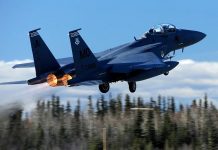
The United States may revisit its long-standing North American Aerospace Defense Command (NORAD) agreement with Canada if Ottawa reverses course on its plan to buy 88 F-35 fighter jets, according to a warning from the U.S. ambassador to Canada.
Speaking amid growing tension over the deal, Ambassador Pete Hoekstra said that a reduced Canadian purchase would create security shortfalls that the U.S. would have to compensate for. He suggested Washington could respond by acquiring additional F-35s for its own forces and increasing its presence in Canadian airspace.
While NORAD currently allows both countries to operate within each other’s airspace to monitor and intercept threats, Hoekstra indicated that any expanded U.S. role would go beyond existing arrangements and require changes to the Cold War-era pact. “NORAD would have to be altered,” he said.
The ambassador’s remarks follow indications from the Canadian government earlier this year that it was reassessing the fighter jet agreement after costs exceeded expectations. Canada committed in 2022 to buying 88 F-35A aircraft from Lockheed Martin, initially funding 16 jets as part of the program.
However, production delays and rising expenses soon became an issue. A preliminary audit in 2025 revealed the projected cost had climbed to $27.7 billion, significantly higher than the original estimate of $19 billion.
Against the backdrop of strained U.S.–Canada relations—exacerbated by tariff threats from President Donald Trump—Prime Minister Mark Carney ordered the review. He emphasized that while Canada cannot influence U.S. political decisions, it can control its own defense spending, contracting choices, and job creation at home.
Hoekstra also cautioned that choosing an alternative aircraft, such as Saab’s Gripen E, would still force the U.S. to rethink its defense coordination with Canada. He argued that moving away from the F-35 would reduce interoperability between the two countries’ forces, weakening joint defense capabilities and requiring the U.S. to find ways to offset that gap.
The comments reflect a broader pattern of pressure from U.S. officials on allied nations to align with Washington’s security priorities, following recent threats by Trump to impose tariffs on European allies over their reluctance to support a U.S. proposal related to Greenland.