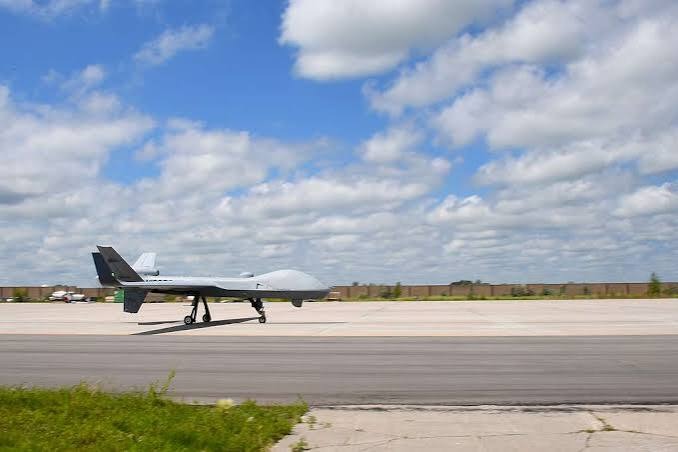
The Indian Navy currently operates two leased MQ-9B unmanned aerial vehicles (UAVs) under a Contractor Owned, Contractor Operated (COCO) arrangement. The lease, which has already been extended several times, is now set to expand, with two additional aircraft bringing the total number of leased MQ-9B High-Altitude Long-Endurance (HALE) UAVs to four for a limited period, according to The Indian Express. The latest arrangement is expected to remain in place until the Navy begins receiving the MQ-9Bs ordered by India in 2024.
The Navy’s existing MQ-9B fleet suffered an incident on September 18, 2024, when one of the two aircraft operated by General Atomics experienced a technical malfunction and was forced to ditch in the sea off Chennai. A replacement UAV was subsequently provided by February 2025 in accordance with the contractual terms.
India signed a government-to-government agreement with the United States on October 15, 2024, for 31 MQ-9B SkyGuardian and SeaGuardian UAVs. The aircraft will be distributed among the three armed services, with the Navy receiving 15 platforms and the Army and Indian Air Force (IAF) receiving eight each. Deliveries are expected to begin in 2029. Reports have also indicated that the aircraft could be integrated with the DRDO-developed NASM-SR anti-ship missile.
The US State Department’s notification covering the Foreign Military Sale placed the estimated value of the package at almost $4 billion. The proposed package includes 170 AGM-114R Hellfire missiles and 310 GBU-39B/B Laser Small Diameter Bombs, along with anti-submarine warfare equipment such as AN/SSQ-62F, AN/SSQ-53G and AN/SSQ-36 sonobuoys. It remains unclear which elements of the overall package India ultimately chose to acquire. The two newly leased MQ-9Bs are expected to have a configuration broadly comparable to the aircraft being procured.
In October 2024, India also signed an agreement with General Atomics Global India Pvt Ltd for Performance Based Logistics support for the 31 remotely piloted aircraft systems. The arrangement includes depot-level maintenance, repair and overhaul facilities in India.
The additional MQ-9B lease represents the latest move by the Indian Navy to strengthen its long-endurance, drone-based maritime intelligence, surveillance and reconnaissance (ISR) capabilities, particularly in support of its P-8I fleet. The Navy operated the Searcher Mk II UAV for approximately 22 years before retiring the platform in December 2024. Heron Mk1 UAVs continue to form part of the service’s inventory. Alongside leasing MQ-9 HALE platforms and pursuing the acquisition of 15 such aircraft, the Navy has also expanded its use of medium-altitude long-endurance (MALE) UAVs.
The Navy ordered two Hermes 900 UAVs, manufactured in India by Adani Defence under the Drishti 10 Starliner designation. The first aircraft was delivered in January 2024. The second was lost at sea in January 2025 during manufacturer-led pre-acceptance trials and is expected to be replaced. More recently, in July 2026, another Navy Hermes 900 crashed near Porbandar airfield during a training sortie.
Reports in 2024 indicated that the Navy was considering the acquisition of four indigenous DRDO TAPAS UAVs. However, no contract has been placed so far. The service is also expected to induct the Heron Mk2 UAV.
The Navy further expanded its shipborne unmanned capabilities in 2024 by inducting eight Schiebel Camcopter S-100 rotary-wing UAVs. The platform had originally been evaluated by the Navy as far back as 2007.
Meanwhile, Indian engineering and defence major L&T and General Atomics Aeronautical Systems Inc. (GA-ASI) established a strategic partnership in October 2025 aimed at manufacturing MALE remotely piloted aircraft in India. The two companies subsequently submitted a bid for an ongoing programme to procure 87 MALE UAVs collectively for the Army, IAF and Navy. The IAF is leading the acquisition process, with nine other companies and consortiums also reportedly being considered.