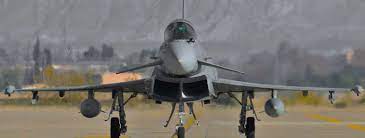
BAE Systems said its Eurofighter Typhoon production line is secured with orders through the period leading up to the start of final assembly for the sixth-generation stealth aircraft being developed under the Global Combat Air Programme (GCAP).
Speaking to analysts after the company released its full-year earnings results, Chief Executive Officer Charles Woodburn said the company has confirmed production demand extending to the point when GCAP aircraft assembly begins, calling it an important milestone for the business.
Additional Eurofighter orders were placed by Spain and Italy toward the end of 2024, followed by Germany in October 2025. Turkey also joined the program as a new customer that month, with deliveries scheduled to continue into the mid-2030s. The GCAP initiative, a collaboration between the United Kingdom, Italy, and Japan, aims to introduce the next-generation fighter into service by 2035.
In June 2025, the Eurofighter consortium—comprising Airbus, BAE Systems, and Leonardo—announced plans to raise annual production to 20 aircraft by mid-2028 from the current rate of 14, with a longer-term goal of reaching 30 jets per year. Woodburn said the company is progressing toward its goal of doubling production capacity, citing Turkey’s order as a key step and noting further opportunities ahead. He added that production rates could be increased further if additional contracts are secured.
BAE Systems manufactures the aircraft’s front fuselage and vertical stabilizer, while Airbus produces the center fuselage and right wing, and Leonardo builds the left wing. BAE and Leonardo jointly supply the rear fuselage. Woodburn said there are ongoing prospects for both new aircraft sales and support contracts, including potential European orders, and highlighted the aircraft’s enhanced capabilities with MBDA’s latest missile systems.
The Eurofighter can be equipped with MBDA’s Meteor beyond-visual-range air-to-air missile, widely regarded as one of the most advanced in its class, along with the Storm Shadow cruise missile. Turkey’s acquisition package includes the Meteor, a development that had previously raised concerns in Greece in early 2025.
Woodburn also said the GCAP project is progressing well and expressed strong satisfaction with the partnership. When asked about the possibility of Airbus joining GCAP if the rival French-German-Spanish Future Combat Air System (FCAS) program collapses, he declined to comment on specifics, noting that such decisions rest with the governments of the U.K., Italy, and Japan. He emphasized that the current partnership is strong and moving forward rapidly.
Europe is becoming a more significant market for BAE Systems, with regional sales rising 28% in 2025 compared with overall company growth of 8%. While the United States remains the company’s largest market, followed by the U.K., Europe accounted for 32% of BAE’s order backlog by the end of December, though it represented 11% of 2025 sales. Woodburn said he expects substantial growth in Europe over the next five years as the company expands its backlog.
BAE anticipates benefiting from increased European defense spending through its regional operations, such as Hägglunds in Sweden, its involvement in Eurofighter and MBDA, and partnerships with firms like Poland’s PGZ, which could leverage European Union defense financing programs. Woodburn said Europe is expected to be a major growth driver, supported by both U.K.-based exports and the company’s expanding European footprint.