
French Army Expands Dedicated Drone-Combat Units After Ukraine War Lessons
The French Army drone units programme is gathering momentum as France moves to integrate dedicated unmanned combat formations into its conventional forces. Inspired by developments in Ukraine, the initiative follows experiments by the 1st Marine Infantry Regiment (1er RIMa), which transformed one of its light cavalry squadrons into a formation specialising in surveillance and combat drones.
The experiment demonstrated how relatively small teams of drone operators could disrupt armoured formations, expose command posts and interfere with an adversary’s ability to manoeuvre. France is now accelerating the creation of similar formations, with Army leaders outlining plans for a substantial expansion by 2027.
The change is also reshaping the roles of soldiers who previously operated conventional weapons systems. Corporal Igor, for example, moved from serving as a gunner on the Army’s AMX 10 RC reconnaissance vehicle to becoming a first-person-view (FPV) drone pilot.
During a June exercise at the Mailly-le-Camp training area east of Paris, he operated an FPV drone from concealed positions among tall grass and vegetation.
“We’re switching specialties, we’re keeping up with the times,” he said.
French Army drone units move from experimentation to expansion
The 1er RIMa’s experimental formation emerged from discussions within the regiment’s training and operations office in late 2023. The objective was to develop a new way of employing drones rather than simply adding unmanned aircraft to existing military units.
The concept was proposed by Captain Guillaume, an open-source intelligence specialist who had been following the evolution of drone warfare in Ukraine.
An early tactical exercise produced encouraging results. According to Colonel Aymeric Caussin, commander of the 1er RIMa, the experimental drone unit generated an unusually high level of disruption during the exercise.
The regiment subsequently decided to develop the concept into a dedicated formation.
The resulting unit, known as the 1er Escadron de Drones de Chasse, or 1st Hunter-Drone Squadron, draws on the regiment’s light cavalry traditions. Its approach combines reconnaissance, intelligence gathering, mobility and attacks against enemy forces.
Lieutenant Colonel Remi, who helped implement the concept, described the formation as a mobile force whose principal weapon system is the drone.
Its mission follows traditional light cavalry principles: identify the enemy, fix its position, outflank it and ultimately destroy it. Mobility, dispersion and concealment remain central to the approach.
The squadron combines several types of unmanned systems, including intelligence, surveillance and reconnaissance (ISR) drones, FPV one-way attack drones and loitering munitions.
Exercise Hedgehog demonstrated the impact of drone warfare
The 1er RIMa first tested the concept during Exercise Hedgehog in Estonia in May 2025. Approximately 10 drone pilots joined a French combined-arms tactical group during the exercise.
The opposing force was provided by the US Army’s 5th Squadron, 7th Cavalry Regiment, which deployed dismounted soldiers and M2A4 Bradley Fighting Vehicles.
The exercise highlighted the vulnerability of conventional formations to drone operations. Ukrainian operators participating in the event had also demonstrated how unmanned systems could expose weaknesses in NATO-style military tactics.
The French contingent produced similarly striking results.
According to Major Sylvain, head of operations at the 1er RIMa, the drone pilots accounted for approximately 20% of the attrition inflicted on the American opposing force in a single day. They represented only around 5% of the French tactical group’s active strength.
The results strengthened the case for expanding the experiment.
Within two months, the drone squadron was formally established. In early April 2026, the French Army staff declared it fully operational.
The regiment also used Exercise Hedgehog to work with defence technology companies. Alta Ares, Icarus Swarms and Naval Group participated in the exercise, with Naval Group joining at its own expense.
Their areas of cooperation include:
- Alta Ares: Artificial intelligence-enabled detection and reconnaissance.
- Icarus Swarms: Autonomous navigation and computer-assisted piloting.
- Naval Group: Drone-launch canisters.
The regiment has continued testing the capabilities in subsequent exercises. During France’s large-scale Orion 2026 exercise, its drone operators recorded simulated strikes against four regimental command posts, logistics convoys, anti-drone units and air-defence systems, according to Caussin.
Drone formations target command posts and disrupt manoeuvres
The French Army’s experience suggests that dedicated drone formations can offer more than an additional source of firepower.
Colonel Caussin identified their responsiveness as a major advantage. FPV drones can rapidly exploit gaps in enemy positions, target important operational axes and interfere with command structures.
The ability to identify and attack command posts is particularly significant because it can affect how an opposing force receives information and makes decisions.
During Orion 2026, ISR drones detected tactical command posts several kilometres behind the front line. The information was then used to direct artillery fire or FPV drone attacks.
Staff Sergeant Tristan, who leads a platoon of FPV pilots after approximately 12 years operating the AMX 10 RC, said the regiment had inflicted considerable damage during the exercise. However, he also cautioned that an adversary equipped with comparable drone capabilities could have caused similar losses.
The regiment had encountered comparable effects during a March exercise at Mailly-le-Camp. Acting as the opposing force in the combat preparation of another French light-cavalry regiment, the 1er RIMa used drones to identify and attack armoured vehicles, command posts and troop concentrations.
The simulated attacks disrupted enemy movement and effectively neutralised the opposing formation.
These results encouraged the Army to extend the experiment to other regiments.
France plans additional combat-drone squadrons by 2027
The French Army is moving towards a wider network of dedicated drone-combat formations.
Following the 1er RIMa experiment, the Army identified five additional regiments for the creation of all-drone squadrons, with the intention of making them operational in 2027.
General Bruno Baratz, head of Future Combat Command, said in September that six combat-drone units were expected to be operational by 2027.
The 6th Armoured Brigade was assigned responsibility for establishing two of the five additional squadrons. However, the brigade decided to create a third formation using its own resources.
General Maxime do Tran, commander of the brigade, said the decision reflected the value demonstrated by the 1er RIMa experiment. One of the brigade’s infantry regiments has already deployed to Romania with a drone-combat unit.
The Army’s broader ambitions are even larger. Army Chief of Staff General Jacques de Montgros told lawmakers at an October 14 hearing that France was aiming for approximately 15 drone-combat units by summer 2027, with further expansion planned thereafter.
France has also begun deploying these capabilities beyond its national training areas. A drone-combat unit was sent to Romania for the first time as part of Mission Aigle, the French-led mission supporting NATO’s eastern flank. A second unit is scheduled to participate in an exercise in Poland.
De Montgros described the deployments as evidence that the Army was moving into a phase of accelerated development.
Different regiments will employ drones for different missions
The French Army does not intend to give every drone-combat squadron an identical role. Their organisation and operational priorities will depend on the type of regiment they support.
The 1er RIMa’s squadron, which has a light-cavalry and reconnaissance background, places considerable emphasis on intelligence gathering and reconnaissance.
Infantry formations, by contrast, are expected to use combat drones primarily to deliver lethal firepower.
For regiments equipped with Leclerc main battle tanks, drone units will focus on protecting armoured columns.
The 6th Armoured Brigade has also adopted an approach that preserves the conventional skills of its drone operators. Personnel previously trained on Akeron anti-tank missiles or 81 mm mortars will continue to maintain those capabilities alongside their drone training.
General do Tran said this was necessary because drone operations can be affected by unfavourable weather. Maintaining other weapons skills ensures that units retain their ability to engage the enemy when unmanned systems cannot be employed effectively.
The brigade’s exercises also exposed another limitation: drones cannot replace the physical presence of soldiers on the ground.
Even when drone operators initially achieved a high degree of saturation, a numerically superior enemy could still break through positions that lacked sufficient infantry.
Commanders therefore concluded that drone operators must operate alongside troops equipped with conventional weapons.
Drone warfare exposes the limitations of conventional forces
The French Army’s experiments have also highlighted how exposed conventional armoured formations can become in an environment dominated by unmanned aircraft.
During the March exercise at Mailly-le-Camp, the opposing regiment had limited anti-drone capabilities and relatively few drones of its own. Officers from the 1er RIMa cautioned that the results should therefore not be treated as a definitive assessment of how the squadron would perform against a better-equipped adversary.
The June exercise was designed to provide a more demanding assessment.
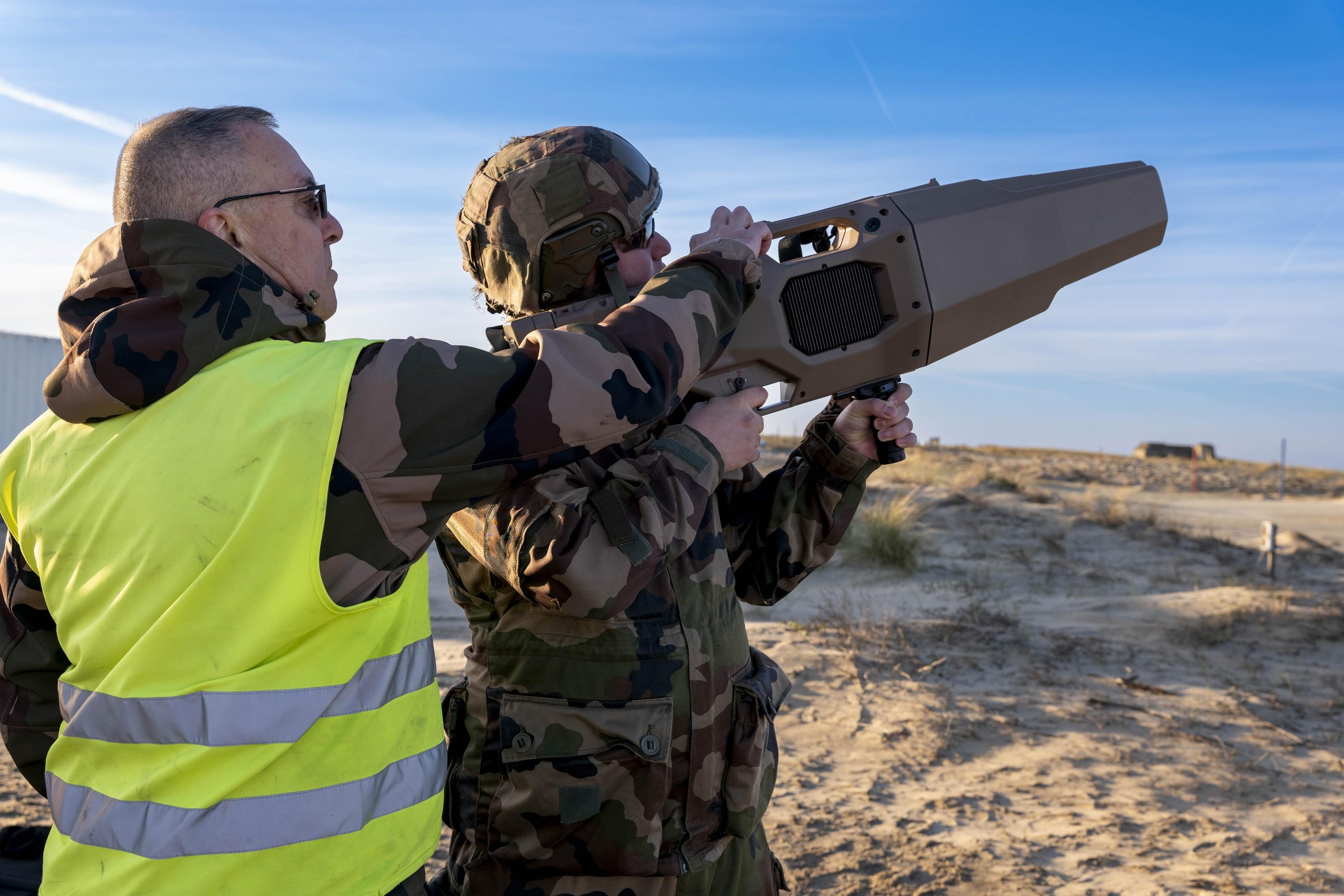
The training centre introduced a more contested electronic-warfare environment and placed greater emphasis on concealment and counter-drone measures. Infantry personnel were equipped with 12-gauge shotguns, while soldiers used camouflage to reduce their visibility.
The opposing force also changed its behaviour. It remained more dispersed, avoided moving in large groups and kept vehicles farther from exposed areas until conditions were considered safer.
Soldiers used camouflage umbrellas purchased from Decathlon while moving through the training area. Although the equipment helped conceal their visual signatures, it also made it harder for drone operators to identify targets among the area’s wildlife, including deer and wild boar.
Despite the additional challenges, the 1er RIMa’s drone squadron achieved the highest score among approximately 30 Army units that passed through the Mailly-le-Camp training centre over a 12-month period, according to Lieutenant Colonel Guillaume.
The exercise also reinforced the importance of combining aerial surveillance with the ability to act on the intelligence obtained.
A drone may provide a comprehensive picture of the battlefield, but that information has limited value unless commanders can convert it into action quickly. Traditional infantry forces remain necessary to deliver direct combat power and hold positions.
Electronic warfare remains a major vulnerability
Electronic warfare was one of the most significant challenges encountered during the June exercise.
Jamming reduced drone effectiveness on several occasions, allowing the opposing force to move armoured vehicles forward, establish temporary advantages and secure objectives.
The experience exposed a need to distinguish between enemy electronic interference and failures caused by the drone operators themselves.
According to Caussin, the regiment must become better at recognising when an adversary is actively jamming its systems and when a failed operation is simply the result of poor execution.
The exercise also reinforced the conclusion that combat drones complement rather than replace armoured formations.
In an environment where both sides possess substantial drone capabilities, units will have to prioritise targets and adapt their employment of unmanned systems instead of assuming they can observe and strike targets without interruption.
The Army also recognises that drones remain vulnerable to weather, electronic warfare and dedicated counter-drone systems. Conventional weapons and platforms therefore retain important roles in deep-strike operations, close combat and direct engagements.
French Army tests autonomous drone swarms
Alongside developing its operational doctrine, the 1er RIMa is working with industrial partners to improve the technology available to its drone formations.
One of the concepts under development involves a so-called queen-and-workers arrangement.
Under this approach, an operator would control a larger drone, referred to as the queen, which would coordinate multiple smaller worker drones launched from a canister or hive.
The intended system would allow an operator to assign a mission to the queen drone. It would then autonomously search for and identify the designated target before directing the worker drones to engage it, with no further intervention from the operator.
The concept is intended to support autonomous terminal guidance and what Major Sylvain described as a fire-and-forget engagement capability.
The regiment and its industry partners have made progress on communications between the queen and worker drones, as well as terminal guidance, although officers acknowledge that the technology is still being developed.
The squadron’s mobile structure is expected to support the concept. Staff Sergeant Tristan said the plan is to carry four drone-launch hives at the rear of a vehicle, allowing several drones to be deployed from a mobile platform.
The squadron is also working towards improved performance from FPV attack drones.
According to Tristan, hit rates can range from approximately 5% to 10% for novice pilots and reach around 30% for experienced operators. This compares with a reported hit probability of more than 90% for the AMX 10 RC’s 105 mm cannon.
The regiment hopes autonomous terminal guidance will eventually raise drone hit rates to approximately 80%–90%.
Its doctrinal objectives include FPV strikes at distances of up to 10 kilometres. Communication range remains the principal practical obstacle to achieving this goal.
The ISR platoon operates several drone models from Parrot and is beginning to achieve the ranges of up to 20 kilometres envisaged in its doctrine.
French drone squadron retains conventional military structure
Despite its focus on unmanned systems, the 1er RIMa’s squadron retains much of the organisational structure of an armoured reconnaissance unit.
It has a command and logistics platoon, supported by four combat platoons:
- One intelligence, surveillance and reconnaissance platoon.
- Two FPV drone platoons.
- One platoon operating longer-range loitering munitions.
Approximately 100 of the unit’s 120 personnel are drone pilots. According to Lieutenant Colonel Remi, this allows the squadron to conduct intelligence and strike operations across an area normally covered by a much larger formation.
The unit’s operating model also changes its logistical requirements. Instead of primarily transporting conventional ammunition, supply vehicles carry drones and related equipment. Maintaining sufficient energy supplies to recharge batteries in the field is another important requirement.
Corporal Igor said he might use between 10 and 20 drones during a day of exercises and simulated strikes.
The drone teams also operate alongside conventional military personnel. FPV pilots are paired with a driver and vehicle commander, with an optional fourth crew member operating a Parrot drone or another ISR system for target identification.
The teams continue to carry Heckler & Koch rifles, heavy machine guns and AT4 shoulder-fired anti-tank weapons for protection against enemy infantry and other threats.
The squadron is intended to integrate into larger French Army formations, with interoperability with other French units and NATO allies incorporated into its development from the outset.
France acknowledges that it is not yet ready for high-intensity drone warfare
French officers have been careful not to equate the squadron’s exercise performance with the experience of Ukrainian drone units, which have developed their capabilities through years of active warfare.
Major Sylvain acknowledged that the French Army still has considerable work to do before its formations can be considered ready for deployment in a high-intensity conflict involving an experienced adversary.
The June exercise also highlighted the demands placed on soldiers operating under persistent drone surveillance. Personnel had to remain alert to aerial threats, conceal their movements and adjust routine activities such as eating and sleeping.
The 1er RIMa has also modified its command arrangements. Command posts are dispersed, and commanders deploy in armoured vehicles alongside combat units to reduce the risk of detection.
The regiment’s experience has reinforced a broader lesson: the introduction of drones changes not only how forces attack but also how they must protect themselves.
Corporal Igor acknowledged that the capabilities being developed by the regiment could equally be employed by an adversary. The Army must therefore continue working on ways to detect, evade and defeat hostile drones.
For France, the objective is not to replace conventional military equipment with unmanned systems. Instead, the emerging doctrine seeks to combine drones, armoured vehicles, infantry and electronic-warfare capabilities into a more adaptable force.
The expansion of dedicated drone-combat formations marks an important step in that process. However, the 1er RIMa’s experiments also suggest that success will depend less on the number of drones deployed than on a unit’s ability to combine surveillance, decision-making, mobility and conventional combat power under increasingly contested battlefield conditions.