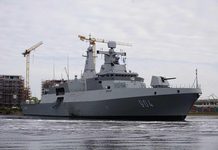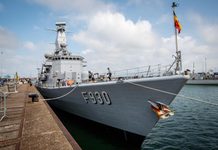
The above image is for representative purposes only.
Western naval forces are increasingly embracing modular ship designs to ensure their fleets remain effective amid rapidly evolving technology, naval leaders said at a recent conference in Paris. This approach allows equipment to be swapped in and out easily—something the head of the Dutch navy compared to snapping Lego pieces onto a vessel.
Modern warship designs are now being built to accommodate containerized systems, and commanders from the United States, Italy, the Netherlands, and the United Kingdom highlighted benefits such as greater mission flexibility, faster deployment of combat capabilities, and the ability to resupply or reconfigure systems while at sea.
Italy’s Thaon di Revel-class patrol frigates, for example, are designed to carry modular mission containers. Similarly, the Netherlands has unveiled plans for multi-role support ships capable of carrying containerized systems ranging from air-defense missiles and electronic warfare equipment to attack drones. The U.S. Navy has also confirmed that its upcoming frigate class will feature modular mission packages.
According to Adm. Giuseppe Berutti Bergotto, chief of staff of the Italian Navy, all future Italian vessels will be built with modular capabilities. While the core function of each ship will remain unchanged, he emphasized the importance of being able to adapt ships quickly for different operational tasks. He also noted that the navy has tested containerized payloads on commercial ships to explore the concept further.
Vice Adm. Harold Liebregs of the Royal Netherlands Navy echoed the Lego analogy, stressing that modular systems already exist but must be kept simple rather than overly integrated. He acknowledged that implementing modularity can be challenging because not all components are fully mature yet, but he encouraged navies to begin integrating the concept and improve over time.
The Netherlands plans to equip its modular ships with containerized Barak ER air-defense missiles and Harop loitering munitions. Liebregs said his navy aims to be combat-ready by 2028 and needs to rapidly increase its maritime firepower. He suggested that modular vessels loaded with missile containers could provide significant air-defense capabilities while enabling dispersed and scalable operations.
These support ships would require only small crews and could also handle tasks such as escorting foreign vessels, reducing the need to deploy high-value warships. Liebregs described modular ships as a cost-effective way to expand fleet capacity and keep pace with rapid technological innovation.
The UK Royal Navy is also testing modular “mission pods” and has emphasized the importance of standardized power and data connections. Gen. Gwyn Jenkins, the First Sea Lord, said that common system interfaces would allow mission pods to be swapped across bases and allied fleets, enabling quick reconfiguration and replenishment.
Berutti Bergotto added that modularity will help navies respond to future threats and integrate emerging technologies such as directed-energy weapons. He also highlighted the importance of being able to update ship designs during construction to avoid obsolescence, noting that some ships commissioned in the past were already outdated due to earlier technological choices.
The U.S. Navy has acknowledged shortcomings in its earlier Littoral Combat Ship modularity efforts, where it underestimated the complexity of developing effective modules. Adm. Daryl Caudle stated that the navy is now investing more in modular design, research, and containerized systems for future surface combatants.
He explained that modular force packages—ranging from weapons to unmanned systems—could be rapidly built and deployed, allowing the navy to tailor force structures more efficiently than traditional large strike groups. Caudle also said modular construction methods could expand U.S. shipbuilding capacity by allowing more shipyards to contribute to different ship sections, speeding up production.
Overall, modularity is seen as a key strategy for modern navies to stay technologically relevant, increase operational flexibility, and enhance fleet-building efficiency.