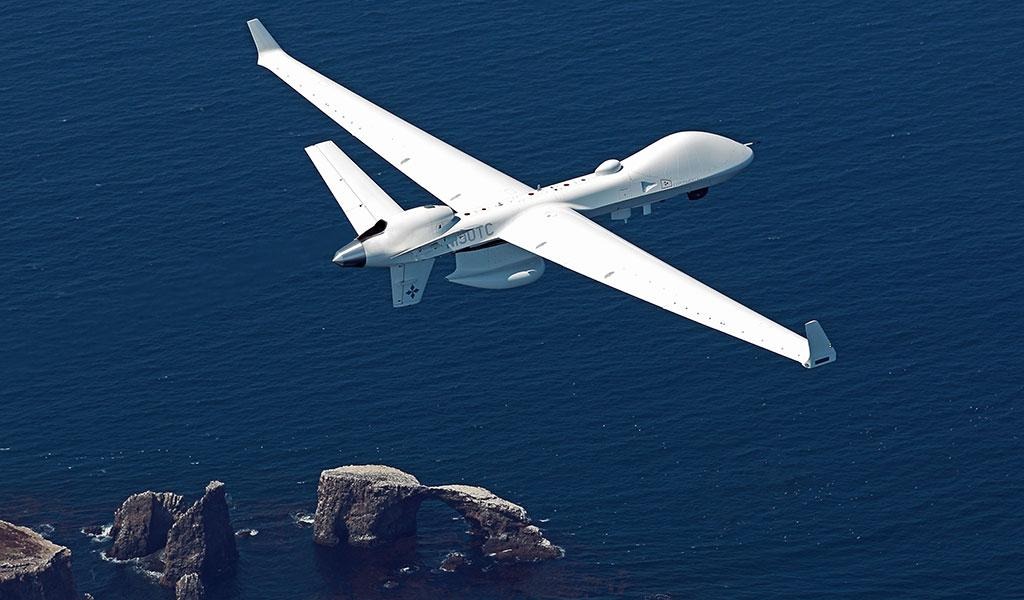
The MQ-9B drone, developed by General Atomics Aeronautical Systems (GA-ASI), is being positioned as a long-endurance, multi-mission uncrewed aircraft for intelligence, surveillance and reconnaissance (ISR), maritime operations and wider defence requirements. Its ability to combine persistent surveillance with different mission configurations is attracting interest from countries seeking to strengthen their uncrewed capabilities.
The United Kingdom, Belgium, Germany, Denmark and Poland are among the European countries identified as having MQ-9B programmes. Canada and India are also pursuing the platform. According to GA-ASI, these programmes reflect demand for uncrewed systems that can help address capability gaps in maritime and expeditionary operations.
The manufacturer presents the MQ-9B as more than an intelligence-gathering aircraft. Depending on its configuration, it can detect and track potential threats and support military engagements across different operational domains.
MQ-9B SeaGuardian and SkyGuardian offer multiple mission configurations
The MQ-9B family includes the SeaGuardian and SkyGuardian variants, which can be configured for a range of missions. These include conventional ISR, strike, airborne early warning and control (AEW&C), anti-submarine warfare, signals intelligence and the employment of long-range weapons.
In certain configurations, the aircraft can remain airborne for more than 30 hours. This endurance is particularly relevant to persistent surveillance requirements across NATO areas of responsibility, including the Arctic.
The aircraft’s certified airworthiness is another element of its operational proposition. GA-ASI also identifies Flight Into Known Icing (FIKI) capability as an upcoming development, with certification still to be completed. If achieved, this would support operations in conditions involving known icing, expanding the range of weather conditions in which the aircraft could be employed.
An established airframe and long endurance
The MQ-9B builds on the MQ-9 airframe, which GA-ASI says has accumulated millions of operational flight hours. The manufacturer argues that using this established design allows the MQ-9B to deliver advanced capabilities at a lower cost than developing an entirely new aircraft.
Its long endurance and integrated sensors can also provide extended surveillance coverage without requiring several specialised platforms to perform separate missions. This combination of persistence and mission flexibility is central to GA-ASI’s cost-effectiveness argument.
Airborne early warning and counter-drone capabilities
One of the MQ-9B’s proposed roles for European defence is airborne early warning and control. GA-ASI has developed an AEW&C mission package intended to improve the detection and classification of aerial threats.
The system is designed to identify both advanced aerial threats and lower-cost, high-density threats such as coordinated drone swarms. It could also extend the surveillance reach of crewed airborne early warning systems already operated by NATO members.
An uncrewed aircraft can undertake missions in airspace considered too dangerous for crewed platforms, potentially reducing risks to personnel and preserving high-value aircraft. It could also provide an additional AEW&C capability when crewed systems are unavailable.
Persistent airborne surveillance could be particularly valuable around critical infrastructure, maritime chokepoints and contested airspace. These locations face growing challenges from cruise missiles, high-speed aircraft and coordinated unmanned aerial attacks.
Combining surveillance with precision engagement
The MQ-9B’s endurance could also support counter-drone operations. GA-ASI has highlighted demonstrations involving the Advanced Precision Kill Weapon System (APKWS), illustrating the aircraft’s potential to engage multiple targets with precision-guided weapons.
The manufacturer describes a possible two-aircraft operating concept. In this arrangement, one MQ-9B equipped with AEW&C would operate as a forward surveillance platform, identifying approaching threats. A second aircraft, armed with APKWS, could remain near critical infrastructure or NATO troop positions and be directed towards the threat.
This would combine persistent detection with a separate engagement capability. However, the example describes a proposed operational concept rather than evidence that such a two-aircraft arrangement is already in routine NATO service.
Long-range weapons expand the MQ-9B’s maritime role
GA-ASI is also working to integrate the MQ-9B with longer-range weapons, including Kongsberg’s Joint Strike Missile and Lockheed Martin’s Long Range Anti-Ship Missile (LRASM).
These weapons are intended to provide precision engagement options at extended distances, including against mobile missile batteries positioned beyond the effective range of opposing air defences. Their potential employment could also support operations in contested maritime areas and on land.
Together with AEW&C and APKWS, these planned and demonstrated capabilities form part of GA-ASI’s effort to present the MQ-9B as a platform capable of combining surveillance, threat detection and precision engagement.
The distinction between existing and developing capabilities remains important: the source describes APKWS demonstrations, while integration work involving the Joint Strike Missile and LRASM is ongoing.
Open architecture allows national defence integration
A central feature of the MQ-9B design is its modular, open architecture. This allows customers to adapt the aircraft to national requirements by integrating their own sensors, weapons, communications equipment and supporting systems.
For European operators, this flexibility could help reconcile national defence requirements with interoperability across NATO and allied forces. It also creates opportunities for domestic companies to contribute components, support equipment and other elements of national programmes.
GA-ASI says it works with each customer to incorporate sovereign systems into their respective programmes.
Canada’s CQ-9B programme, for example, includes national training, ground-support and ground-control systems. The UK’s RG Mk1 Protector programme incorporates British components and munitions.
These arrangements illustrate how the same basic aircraft can be adapted to different national operating structures rather than requiring every customer to adopt an identical configuration.
NATO procurement cooperation through NSPA
Countries seeking to manage acquisition and sustainment costs can also consider procurement through the NATO Support and Procurement Agency (NSPA). The agency provides a framework intended to support the acquisition and maintenance of the MQ-9B.
Denmark launched its MQ-9B programme through an arrangement with NSPA, announced in July 2025.
The approach can facilitate cooperation in areas such as joint procurement, shared maintenance and common spare-parts arrangements. Pooling some of these requirements could reduce costs while helping participating NATO members improve interoperability.
For smaller operators in particular, shared support arrangements may offer a way to access advanced uncrewed capabilities without independently establishing every element of the logistical and maintenance infrastructure.
MQ-9B offers European forces a flexible ISR option
European countries are reassessing their defence requirements in response to changing security conditions, including growing threats to maritime routes, critical infrastructure and national airspace. Persistent surveillance and the ability to operate across different environments have consequently become important considerations in military planning.
GA-ASI’s MQ-9B combines long-endurance ISR with the potential for airborne early warning, maritime surveillance, anti-submarine warfare and precision engagement. Its modular architecture and national integration options also offer flexibility for countries seeking to align procurement with domestic industrial and operational priorities.
From the Arctic to the Mediterranean, the platform is being presented as a means of strengthening situational awareness and supporting NATO cooperation. Its eventual contribution will depend on the capabilities selected by individual customers, the progress of weapons and sensor integration, and the operational requirements of each national programme.