On a frigid morning in northern Norway, British and Norwegian troops moved carefully through a birch forest covered in deep snow. The soldiers were participating in a simulated NATO reconnaissance operation as part of a large-scale military exercise involving around 30,000 personnel. The drills were designed to rehearse a response to an attack by a hypothetical adversary from the east — a clear reference to Russia, Norway’s Arctic neighbor.
Over the last decade, Russia has significantly expanded its military capabilities in the Arctic. It has modernized the world’s largest fleet of icebreakers and reopened numerous military facilities dating back to the Soviet era. These developments have gained strategic importance as climate change opens new maritime routes and because the Arctic provides the shortest trajectory for Russia’s intercontinental nuclear missiles to reach the United States.
The exercises conducted in March formed part of a broader NATO initiative known as Arctic Sentry. The program seeks to demonstrate that European nations and Canada are capable of defending the alliance’s northern territories. NATO Secretary General Mark Rutte introduced the initiative in February while persuading U.S. President Donald Trump to abandon efforts to pursue control over Greenland.
Although Rutte reportedly succeeded in easing tensions with Washington over Greenland, significantly enhancing NATO’s Arctic defenses remains a complex undertaking. Discussions with numerous current and former NATO officials and Arctic specialists indicate that strengthening the alliance’s northern posture will require major long-term commitments.
Such efforts involve extensive investment in assets ranging from icebreakers and submarines to satellites and unmanned systems. These expenditures come at a time when European allies face economic pressures and uncertainty over future U.S. involvement, particularly after Trump raised the possibility of withdrawing from NATO and began reducing America’s military presence in Europe.
For much of NATO’s history, the remote Arctic region received limited strategic attention. However, the combination of melting ice, Russia’s expanding military presence in a resource-rich region larger than the continental United States, and growing Chinese interest has transformed the Arctic into a major geopolitical arena.
“No major global power in this century can sustain its international influence without maintaining a significant Arctic presence in some form,” Olafur Ragnar Grimsson, former president of Iceland and chairman of the Arctic Circle forum, often described as the “Davos of the Arctic,” told Reuters.
Reuters was unable to determine whether the United States has increased or reduced its contribution to Arctic defense operations under Arctic Sentry, which is coordinated by Joint Force Command Norfolk in Virginia. The command was established in 2019 specifically to address growing Russian military activity in the region. In response to Reuters’ inquiries, NATO officials emphasized that the United States remains an essential contributor to Arctic security and noted that this commitment was reaffirmed in a joint statement issued by Arctic allies in June.
Neither the White House nor the Pentagon responded to questions regarding whether ongoing reviews of U.S. troop deployments in Europe could affect Arctic defense operations. Concerns surrounding Washington’s strategic intentions in Greenland, combined with broader uncertainty over American military commitments, are expected to influence discussions at the NATO summit scheduled for Ankara in July.
The White House has previously argued that Trump’s policies have encouraged NATO allies to assume greater responsibility for their own defense while stressing the strategic importance of the Arctic to American security and economic interests.
Russia’s Ministry of Defence declined to comment on the report. In the past, the Kremlin has accused the United States of escalating tensions in the Arctic region.
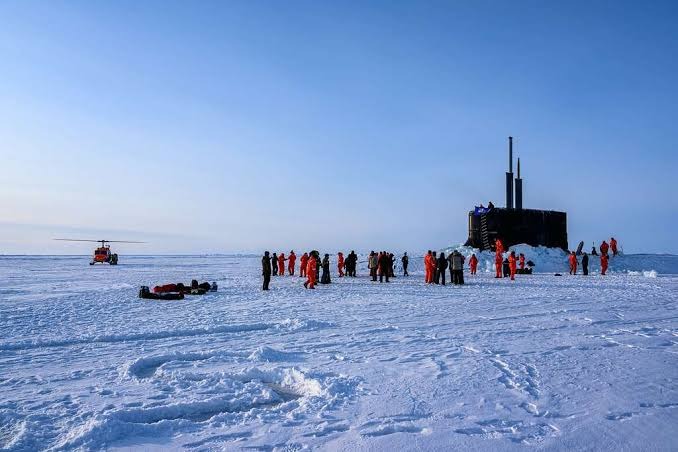
A major concern for European NATO members is monitoring military activity on Russia’s Kola Peninsula, which borders Norway and Finland. The peninsula hosts approximately two-thirds of Russia’s strategic second-strike nuclear capability, including the Northern Fleet, which operates half of Russia’s nuclear-armed submarines.
From bases on the Kola Peninsula, Russia could deploy hypersonic missiles toward North America, increasing the importance of early warning and detection systems. Russian submarines could also move toward the U.S. East Coast through strategic maritime corridors such as the Bear Gap in the Barents Sea and the GIUK Gap, the passage between Greenland, Iceland and the United Kingdom.
Currently, Norway and its NATO partners monitor Russian naval activity in both the Barents Sea and the GIUK Gap. These areas have also experienced incidents involving damaged undersea infrastructure, with some observers attributing the activity to Russia. Norwegian intelligence services conduct surveillance of military installations on the Kola Peninsula and share relevant information with the United States.
However, according to Mauro Gilli, a professor of military strategy at Berlin’s Hertie School, NATO needs to further expand its intelligence, surveillance and reconnaissance capabilities in the Arctic.
Operating in the Arctic is exceptionally expensive because conventional military equipment often performs poorly in extreme conditions. Temperatures in northern Norway, for example, can fall to minus 45 degrees Celsius during winter, excluding wind chill effects.
Given that much of the Arctic region encompassing Greenland, Iceland, northern Norway and the Barents Sea consists of ocean, maintaining security in the region requires substantial naval capabilities. Grimsson noted that this presents a major financial challenge. While the United States currently operates only two active icebreakers, Russia possesses 42, including several nuclear-powered vessels.
Reliable satellite communications capable of functioning at extreme northern latitudes are critical for real-time surveillance, Gilli explained. He also emphasized the need for long-endurance drones designed for severe weather conditions, expanded underwater monitoring systems and additional land-based radar networks. According to his estimates, the necessary investments could total hundreds of billions of dollars.
Climate change itself is creating new military challenges. Research conducted by the NATO Defence College in 2025 suggests that rising ocean temperatures and changing salinity levels are complicating submarine detection. As ocean currents shift, particularly in the rapidly warming North Atlantic, sound behaves differently underwater, reducing the distances at which submarines can be detected.
“We can currently monitor and track submarines operating in the Barents Sea,” Norwegian Defence Minister Tore Sandvik said in January. “If we lose that capability and no longer know where those submarines are, we face a serious problem.”
The strategic importance of Arctic surveillance was underscored in June when Icelandic authorities reported that a Russian intelligence vessel had been observed monitoring NATO exercises in the North Atlantic and operating between Iceland and Greenland.
There are indications that NATO allies recognize the growing challenge. The Nordic countries rank among the alliance’s highest defense spenders and are expected to achieve NATO’s target of allocating 5% of GDP to defense by 2035. Finland and the United States have partnered to build up to six new icebreakers, with the first expected to enter service next year. Norway is expanding its fleet with additional frigates and submarines, while Nordic countries have integrated their air forces to create a combined fleet comparable in size to Britain’s.
Canada, meanwhile, has also intensified its Arctic defense efforts. Motivated partly by Trump’s statements about Greenland and a desire to reduce dependence on U.S. military support, Ottawa announced a C$35 billion Arctic defense strategy in March. The initiative includes significant investment in infrastructure such as military airfields.
Canada is also strengthening cooperation with Nordic nations and collaborating with Denmark on new ice-capable vessels. During a visit to Oslo in March, Prime Minister Mark Carney told Reuters that NATO’s increased attention to Arctic security was both overdue and necessary.
Vice-Admiral James Morley, deputy commander of Joint Force Command Norfolk, said Arctic Sentry provides NATO forces with invaluable experience operating in extreme environments.
“It creates a far more realistic operational setting,” Morley told Reuters at Norway’s Bardufoss air base, where British Royal Marines conduct specialized training using snowmobiles, skis and helicopters.
The United Kingdom plans to increase the number of Royal Marines permanently stationed in Norway to 2,000 personnel. In June, NATO also established a new force comprising 600 troops stationed in Sweden and Finland’s Lapland region.
Nevertheless, Iris Ferguson, who served as the U.S. deputy assistant secretary of defense for Arctic and global resilience from 2022 to 2025, noted that securing resources for Arctic defense remains difficult.
“When an active war is taking place elsewhere, it’s challenging to persuade governments to prioritize investment in a region that appears less immediately threatened,” Ferguson told Reuters, referring to Russia’s invasion of Ukraine.
During the Arctic Sentry exercise, U.S. military commanders sought to reassure their European allies of Washington’s continued commitment.
“Our responsibility is to defend every inch of NATO territory,” Major General Daniel Shipley, commander of U.S. Marine Corps Forces Europe and Africa, said during the exercises in northern Norway.
Despite these assurances, European leaders remain concerned by Trump’s previous comments regarding Greenland and his suggestions that the United States could reconsider its NATO commitments. In recent months, Washington announced reductions in its contributions to NATO’s rapid-response capabilities, including cuts involving fighter aircraft, naval vessels and drones.
Norway, long regarded as one of America’s closest allies in Europe, joined France’s nuclear deterrence initiative in June.
Norwegian leaders increasingly stress that maintaining U.S. engagement in the Arctic serves American interests as much as Europe’s.
“Just 100 kilometers from our border lies the world’s largest nuclear arsenal,” Prime Minister Jonas Gahr Stoere said while recalling a conversation with President Trump during a White House meeting in February. “It is not aimed at Norway, Mr. President. It is aimed at the United States.”