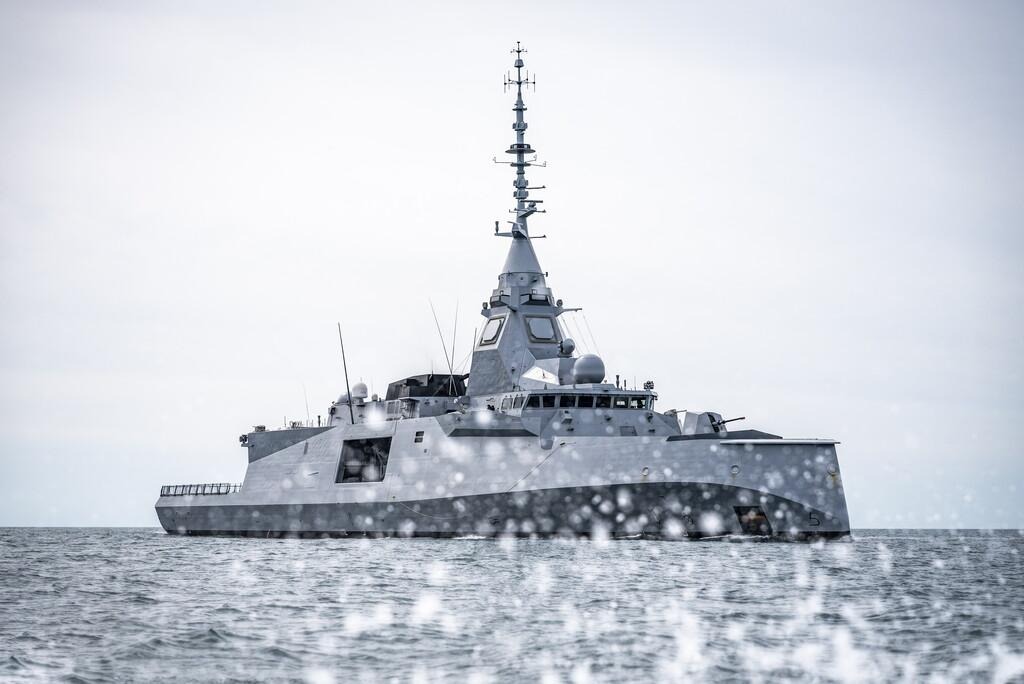
France’s Defense and Intervention Frigate (FDI) is demonstrating the operational benefits of its distinctive inverted bow, according to the former commander of the class’s lead vessel, Amiral Ronarc’h. The unusual hull design is intended to improve seakeeping, reduce structural stress and provide greater stability when operating in challenging sea conditions.
Nicolas Guiraud, a former French Navy captain who commanded Amiral Ronarc’h during its sea trials and subsequent operations, said the design allows the frigate to cut through waves with less impact. Guiraud, who completed his command in July and now serves as a marketing director at the shipbuilder Naval Group, said the resulting reduction in slamming also significantly reduces vibrations throughout the vessel.
French FDI Frigate’s Inverted Bow Reduces Structural Stress
According to Guiraud, reduced vibration has implications beyond crew comfort. It can also help limit long-term structural deterioration and protect sensitive electronic equipment.
“Fewer vibrations mean a ship that ages much more slowly, cracks that won’t form, computer connectors that won’t disconnect,” he said during an interview at the Euronaval maritime defence exhibition in Paris on November 4.
He added that improved onboard comfort is another benefit, although it was not the primary motivation behind the design. A less physically demanding environment helps sailors remain rested and make better operational decisions.
The French Navy has also defended the frigate’s handling characteristics amid criticism of its unconventional hull configuration. In September, French Navy Chief of Staff Admiral Christophe Cluzel told lawmakers that the FDI had demonstrated exceptional manoeuvrability and stability, contrary to some earlier assessments.
The design is also attracting international interest. Sweden announced plans in May to acquire four FDI frigates, adding to the vessels already operated by the French and Hellenic navies.
Guiraud said the inverted bow initially generated considerable scepticism but has increasingly gained acceptance through operational experience. Naval Group’s decision to incorporate the configuration into an 8,000-tonne drone-carrier frigate concept presented at Euronaval further demonstrates the company’s confidence in the approach.
Naval Group’s Extensive Testing of the Inverted Bow
Although inverted bows were used in 19th-century vessels and have appeared on certain modern support ships, their application to a contemporary frigate represented a significant design departure.
Naval Group began investigating the configuration in the mid-2000s. The development programme extended over more than a decade and included extensive towing-tank experiments, hydrodynamic modelling and radar-signature assessments.
These studies were intended to address concerns about the vessel’s stability and the amount of water that might come over the bow in rough conditions. Naval Group also maintains that the inverted bow offers a smaller radar profile than a conventional flared bow.
The French FDI is not the only modern warship to employ this configuration. The US Navy’s Zumwalt-class stealth destroyers also feature an inverted bow. The design attracted questions about stability, although the commander of the lead vessel said in 2020 that the destroyer performed well in rough seas.
There is, however, an important distinction between the two designs. The Zumwalt class uses a tumblehome hull, which narrows towards the upper sections above the waterline. The French frigate, by comparison, has a flaring hull.
The French Navy received its first FDI, Amiral Ronarc’h, in October 2025.
Amiral Ronarc’h Demonstrates Performance in Rough Seas
Guiraud’s experience commanding Amiral Ronarc’h included an extended deployment covering a wide geographical range, from the Arctic Circle to the Equator.
His earlier service included assignments aboard French FREMM multirole frigates and older-generation warships. On those vessels, monitoring hull fatigue and structural wear was a significant concern. According to Guiraud, feedback from the FDI’s operational experience so far has not indicated similar structural problems.
He attributed this to the combined effect of the inverted bow, the frigate’s length-to-width ratio and its stabilising fins. Together, these features are intended to minimise shocks and vibrations, potentially extending the vessel’s service life.
The frigate has also demonstrated its ability to maintain speed in challenging weather. According to Guiraud, Amiral Ronarc’h has sustained speeds of 20 knots in Sea State 6, characterised by significant wave heights of approximately 4 to 6 metres.
The vessel has encountered conditions reaching Sea State 7, where waves can reach heights of up to 9 metres.
During one Sea State 6 encounter, the frigate had to reduce speed slightly while heading directly into the waves. However, after adjusting its heading so that the waves approached slightly forward of the beam, the ship was able to return to 20 knots without particular concerns about the integrity of its systems.
Operational Capabilities and Range
The FDI’s hull configuration and stabilising fins are also intended to preserve the ship’s ability to conduct military operations in rough weather.
Guiraud said helicopter operations and the deployment of towed-array sonar equipment were not particularly problematic in Sea State 5. Operations in Sea State 6 were more dependent on the wavelength, swell conditions and wind strength.
The FDI has a standard displacement of approximately 4,500 metric tonnes. Nevertheless, Guiraud argued that it offers military capabilities comparable to those of a considerably larger 6,000-tonne frigate.
He highlighted the challenge of retaining operational capabilities while reducing vessel size, noting that smaller ships generally experience more movement in rough seas.
The frigate is powered by a combined diesel-and-diesel propulsion arrangement, which Guiraud described as particularly energy-efficient. Although its advertised range is 5,000 nautical miles at 15 knots, he said the vessel can actually achieve approximately 10% more. Its maximum speed is 27 knots.
Spray Management and Protection of Onboard Equipment
One concern associated with inverted-bow configurations is the potential for increased spray over the forward section of the vessel.
Guiraud acknowledged that the FDI produces spray but said this does not constitute an operational problem. He distinguished between spray and the much more significant danger posed by large masses of water crashing onto the deck and equipment during heavy seas.
To manage water flow, the FDI incorporates spray rails along its hull. These structures help deflect water and reduce the amount reaching sensitive equipment.
According to Guiraud, the ship’s foredeck is not routinely swept by waves. Instead, the equipment is exposed primarily to spray, against which it has been designed and protected.
He also pointed to the height of the frigate’s bow as an important factor. The bow provides substantial protection against waves reaching the forward deck, although no warship can be considered immune to the effects of exceptionally large waves.
Guiraud stressed that, as with any vessel, the crew must continuously monitor sea conditions and adjust the ship’s handling and operations accordingly. In his assessment, however, the FDI does not require fundamentally different operational precautions from those applied to larger warships.
The operational experience of Amiral Ronarc’h is therefore providing Naval Group with an opportunity to demonstrate the practical advantages of its unconventional hull design. While the inverted bow initially raised questions about stability and seaworthiness, the shipbuilder believes the FDI’s performance at sea supports its continued use in future naval platforms.