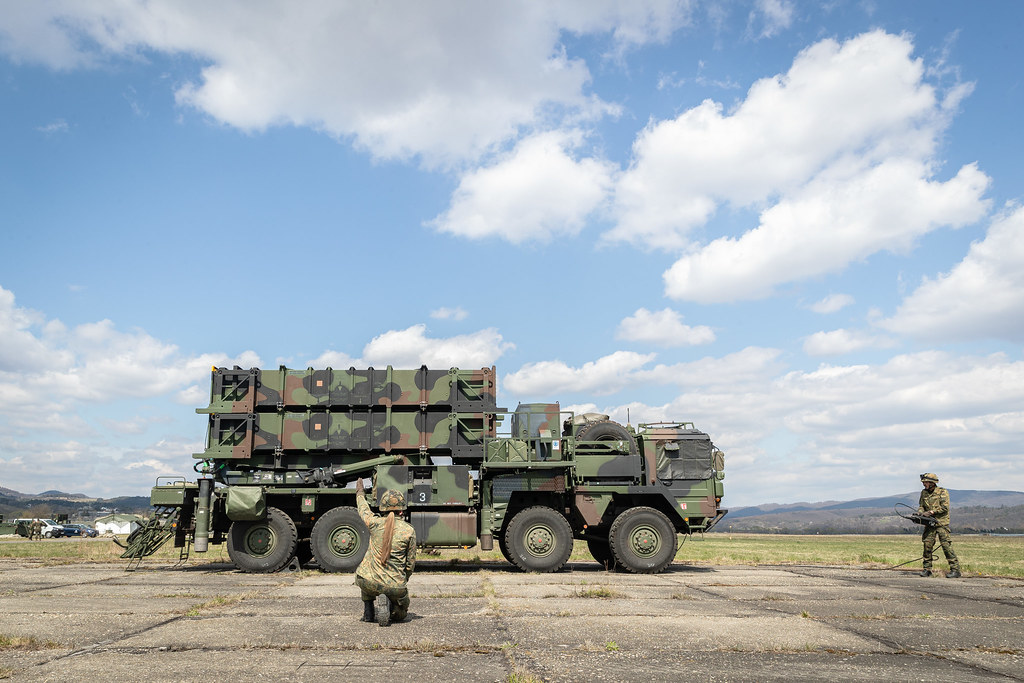
The above image is for representational purposes only.
Ukrainian drone and missile manufacturer Fire Point has reached agreements with more than a dozen European defense companies to contribute radar, guidance and other technologies to the Freyja missile-defense initiative. The company has now begun bringing the various components together, according to CEO Iryna Terekh.
Ukraine has been seeking an accelerated solution to the threat posed by Russian ballistic missiles, which can travel at several times the speed of sound. The multinational Freyja program was formally unveiled in Paris last month, with 10 European governments and 12 defense companies initially participating. Among the firms involved are Eurosam, Leonardo, Thales and Saab.
Ukraine currently depends heavily on U.S.-built Patriot air-defense systems to counter ballistic missiles. However, worldwide constraints on interceptor missile supplies, compounded by the conflict in Iran, have increased pressure on Ukraine’s existing defenses.
“Pretty much everything is agreed,” Terekh told Reuters, saying that 13 industrial partners had already committed to the project. Fire Point is targeting its first successful ballistic-missile interception by the middle of 2027.
Fire Point Integrates Freyja Components
Fire Point is supplying the FP7.X, a higher-speed derivative of its FP7 ballistic missile, as the interceptor for Freyja. The company is currently integrating the missile with the seeker, the system responsible for detecting and guiding the interceptor toward its target.
Terekh described the current phase as both the most demanding and technically complicated part of the program, involving the integration of surveillance radars, tracking radars and seekers into a single system.
Norwegian defense company Kongsberg is developing the command-and-control center that will coordinate the different components. Kongsberg had not immediately responded to a request for comment.
Reports in defense-industry publications have suggested that Germany’s Diehl Defence, which develops seekers for its IRIS-T air-defense system, is involved in supplying guidance technology. A Diehl spokesperson confirmed that discussions with Fire Point were underway but declined to provide further information. Terekh also declined to elaborate.
Fire Point intends to bring the cost of each ballistic-missile interceptor below €1 million ($1.2 million), according to Terekh. That would put the weapon at roughly one-quarter to one-sixth the reported cost of a Patriot interceptor.
The company is attempting to compress a development process that would traditionally span two or three decades into only a few years, Terekh said. She added that the interceptor had already undergone at least five tests.
The Freyja system is being designed around an open architecture, allowing individual components to be replaced with alternatives. For example, a Weibel radar could potentially be exchanged for a Saab system, Ukrainian officials said.
Fire Point expects the industrial consortium to potentially expand to approximately 20 companies, which would also help increase manufacturing capacity. Terekh said the company is also negotiating with Ukrainian state-owned missile manufacturers, although she did not identify them.
The participating companies are expected to fund research and development through the creation of a minimum viable product, which Terekh defined as a system capable of successfully intercepting a ballistic missile.
Interceptor Performance Will Be Critical
The proposed launcher is expected to carry between four and six interceptors. Terekh said that a successful ballistic-missile interception from a single batch of missiles would represent a significant milestone for the MVP.
The effectiveness required of each interceptor is substantial. A missile would penetrate the defense only if every interceptor launched against it failed. According to Fabian Hoffmann, a missile specialist at the Norwegian Institute for Defence Studies, maintaining the probability of six consecutive misses below 5%—a commonly used industry benchmark—would require an individual interceptor to achieve a hit rate of approximately 40%.
Hoffmann said that achieving such performance for around €1 million per interceptor would be both unusually inexpensive and highly impressive.
Fire Point Moves Toward Offensive Missile Production
The FP7 family also includes a strike variant intended for attacks against ground targets. Fire Point has conducted approximately 15 test launches of this version and is now awaiting certification from Ukraine’s Defence Ministry. Terekh estimated that the certification process would take another two to four weeks.
The company expects the FP7 attack variant to see its first combat deployment in early autumn. A substantially larger FP9 ballistic missile is expected to follow later in the autumn. Fire Point claims the FP9 will have sufficient range to reach Moscow.
According to Terekh, the basic architecture of the FP7 was initially influenced by Soviet-era designs associated with the S-300 and S-400 missile systems. She said, however, that the company’s current missile has only about 20% similarity to those earlier weapons.
In a recent interview, Fire Point co-founder Denys Shtilierman said Soviet technical plans had been obtained as a favor from Timur Mindich, a former business associate of Ukrainian President Volodymyr Zelenskiy. Mindich is facing corruption allegations and is currently a fugitive in Israel.
Fire Point has said it rejected an offer from Mindich to acquire an ownership stake in the company.
Company Develops Its Own Engine for Flamingo Cruise Missile
Fire Point is also working to develop an indigenous engine for its FP5 cruise missile, known as Flamingo. The missile has reportedly been used against several significant military targets in Russia this year.
Until now, the company has relied on used jet engines, with Terekh describing the search for suitable units as akin to looking through an “engine cemetery” or searching for parts in a second-hand store.
As supplies of suitable used engines become increasingly difficult to obtain, Fire Point is assembling the first 10 examples of its own prototype engine.
Terekh said the company plans to significantly expand Flamingo production once testing confirms that the new engines perform satisfactorily.