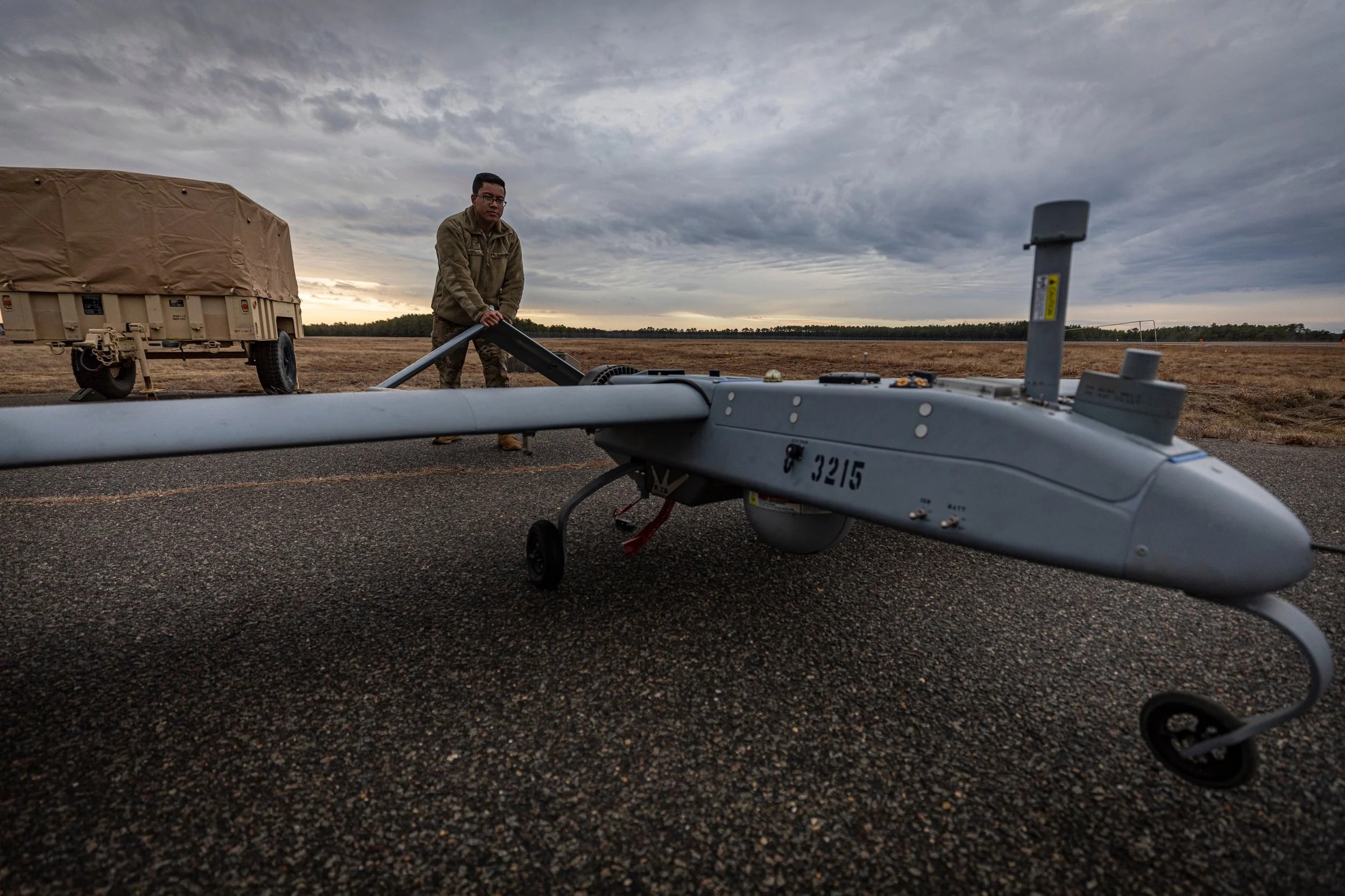
The above image is for illustrative purposes only.
France’s effort to bring its automotive manufacturing sector into military drone production is moving from concept to execution, with automakers, component manufacturers and defense companies joining forces to translate battlefield lessons from Ukraine into high-volume production capabilities.
Since the beginning of the year, at least six partnerships linking the automotive and defense industries have been announced. The government of President Emmanuel Macron is looking to harness the French auto sector’s expertise in automation, large-scale manufacturing and cost control to expand one of the fastest-growing areas of modern military technology.
The extensive use of drones by both Ukraine and Russia has fundamentally changed battlefield operations. France and its European partners are consequently placing greater emphasis on expanding drone manufacturing capacity, while pressure from Washington for European nations to strengthen their defense capabilities has further accelerated the effort.
The emerging projects suggest that France is working toward an industrial system capable of manufacturing tens of thousands of drones annually. Such volumes would be difficult for small defense startups to achieve independently, although they remain far below the production levels being pursued by Ukraine and Russia.
France Seeks High-Volume Drone Manufacturing
“Why now? Because the need is now, drones are now,” Valeo CEO Christophe Périllat told journalists in late July. “And why in France? Because we’re being asked to guarantee our sovereignty.”
French defense authorities do not expect France to require thousands of drones over its own territory in the immediate future. However, officials argue that the country needs to be ready to respond if a major conflict breaks out.
The strategy is therefore focused on establishing manufacturing capacity that can be rapidly expanded during a crisis. A French Senate defense committee report published in July said the country currently possesses only several thousand drones, describing that inventory as inadequate for reaching a meaningful level of operational mass.
Automotive supplier Valeo plans to produce electric motors for military drones in France for defense technology company Harmattan AI. Forvia, meanwhile, announced a partnership last week with a European defense business focused on AI-enabled counter-drone technology. The company is also considering the creation of French manufacturing capacity capable of producing as many as 1,000 interceptor drones each month.
Renault is already collaborating with Turgis & Gaillard on a long-range drone and in June joined forces with Thales to move the Toutatis loitering munition into industrial-scale production. The partners are aiming for manufacturing rates of as many as 1,000 units per month from 2027.
Also in June, French drone manufacturer Delair and German automotive supplier Schaeffler announced plans for a French production facility designed to manufacture approximately 100 drones per day by November.
Making Drones Easier to Manufacture at Scale
If the production ambitions announced by Renault, Schaeffler and Forvia are achieved, their combined capacity could approach 60,000 drones annually. Even that volume, however, would be insufficient for the demands of a major war.
Drones have been part of military operations for decades, but their use has expanded dramatically during the war in Ukraine. Unmanned systems have become central to battlefield operations and account for a large share of casualties. Persistent aerial surveillance and drone attacks have transformed areas near the front into highly dangerous zones, forcing troops to seek protection underground.
Following Russia’s full-scale invasion in 2022, Ukraine rapidly expanded drone deployment across reconnaissance, battlefield attack and long-range strike missions. Ukrainian President Volodymyr Zelenskiy said in July that the country expects to manufacture 10 million drones during 2026.
Ukraine now has a vast network of drone manufacturers ranging from small startups to larger producers. In some cases, manufacturers are producing more systems than the Ukrainian military can currently purchase, prompting the government to cautiously consider allowing some surplus output to be exported.
Patrick Pailloux, who heads France’s defense procurement agency, said the government was working particularly closely with automotive subcontractors to develop drone designs that could be manufactured in very large numbers.
He emphasized that mass production presented a different challenge from building drones at a defense startup. The objective is to create systems that can be reproduced at very high volumes with automated production equipment and industrial robots.
Renault CEO François Provost said in June that the Toutatis drone was being redesigned to reduce the number of components and replace its current 3D-printed construction with injection-moulded plastic. The changes are intended to make the system cheaper and better suited to high-volume manufacturing.
Building Capacity Without Creating Obsolete Stockpiles
French defense officials face another dilemma: expanding manufacturing capacity sufficiently to respond to a conflict without accumulating huge inventories of drones that could quickly become outdated as technology advances.
Thales CEO Patrice Caine said this summer that drones evolve rapidly as new technologies emerge, making them particularly susceptible to becoming obsolete.
Pailloux said France needed enough drones to provide meaningful training opportunities while also maintaining sufficient manufacturing capacity to respond to a sudden military crisis.
The French government has already committed substantial funding toward that objective. Prime Minister Sébastien Lecornu announced a €150 million ($175 million) investment last December to help establish a dedicated domestic drone industry.
However, France’s drone manufacturers say government support and production orders still need to increase. Antoine Level, head of the country’s drone industry association, said Germany had moved ahead of France in financing short-range drone programs and warned that French manufacturers still lacked sufficient orders to provide the industry with the strong demand needed to expand.