
France’s 68th African Artillery Regiment is changing the way its artillery batteries are organized, breaking gun crews into smaller, more dispersed units and establishing a dedicated support section responsible for preparing firing locations and deploying decoys.
The changes are designed to improve the regiment’s ability to survive on a battlefield where persistent drone surveillance and counter-battery attacks can quickly expose artillery positions.
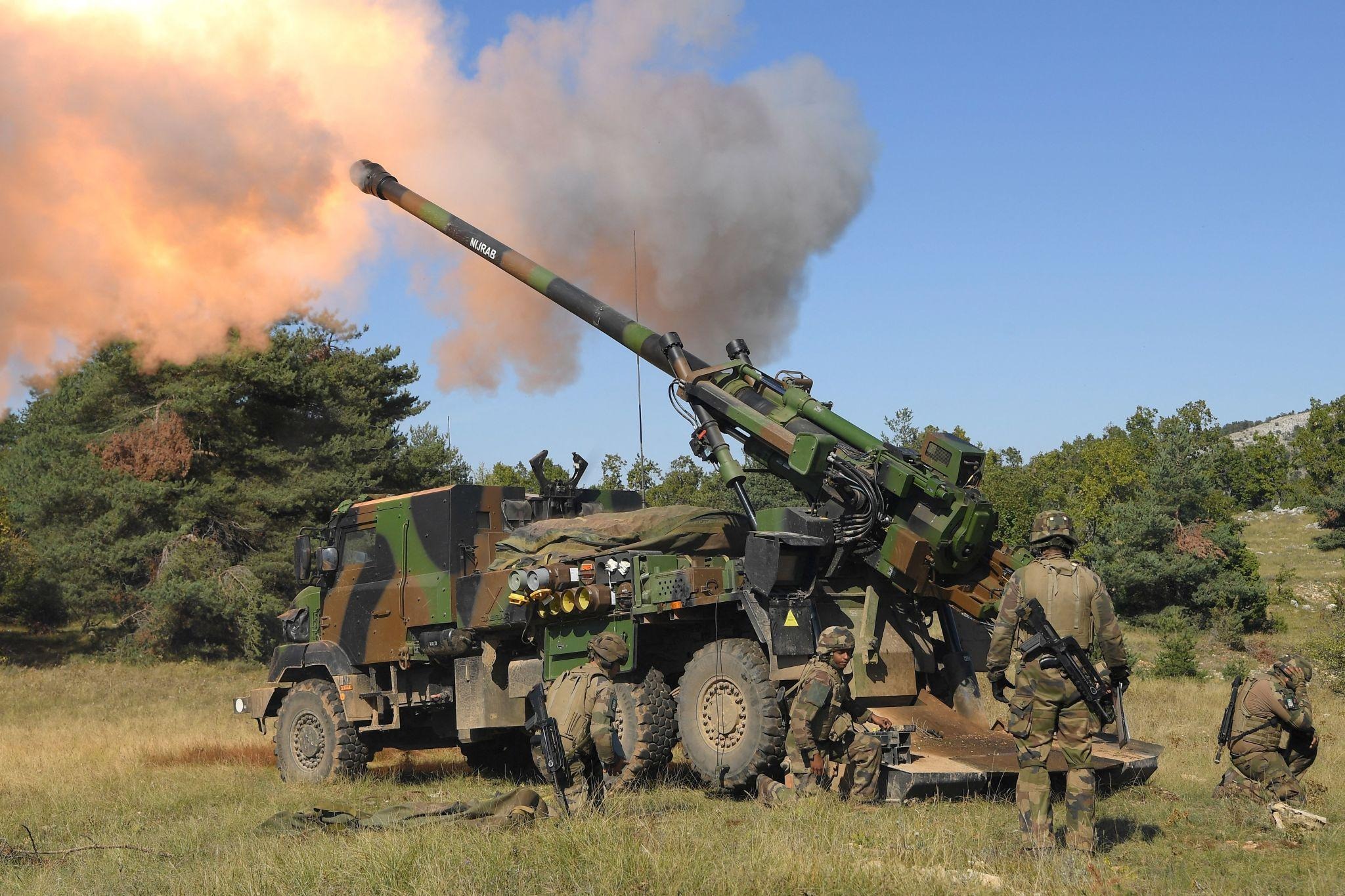
The 68e RAA is reorganizing its batteries of 155 mm Caesar self-propelled howitzers from two four-gun sections into three sections, each equipped with two guns. The regiment’s overall number of truck-mounted Caesar howitzers is not changing at this stage, according to Col. Rémy Jaillet, the unit’s commander.
Despite dispersing the guns, the regiment will use the Atlas fire-control system to coordinate the individual sections and retain the ability to concentrate artillery fire when required. Jaillet discussed the changes during an innovation event held by France’s 7th Armored Brigade at its headquarters in Besançon.
Jaillet said that dividing the artillery into smaller pairs can actually improve the availability and responsiveness of fire support. He also noted that more widely dispersed units are harder to target and can remain more resilient when operating in an environment characterized by heavy counter-battery activity.
Learning From the War in Ukraine
The restructuring reflects lessons being examined by NATO militaries from the conflict in Ukraine. Persistent drone surveillance has made conventional artillery firing positions increasingly vulnerable to detection and subsequent counter-battery strikes.
An analysis by the Royal United Services Institute has documented Ukrainian efforts to address these threats by spreading artillery pieces across larger areas, reducing the duration of firing missions, concealing positions and keeping ammunition separate from gun positions.
Jaillet emphasized that the new arrangement is currently an initiative of the 68e RAA rather than an established standard for the entire French Army. Under the revised organization, individual batteries operate fewer guns, while the overall number of batteries increases.
The 68e RAA is one of six French Army artillery regiments operating the Caesar, manufactured by KNDS. Under the Army’s current model for a combat-ready brigade, an artillery regiment is equipped with 16 Caesar self-propelled howitzers and eight MEPAC mortar systems.
Dedicated Support for Firing Positions
A major element of the new organization is the creation of an artillery-support section. Rather than having each gun section maintain its own small reconnaissance capability, this dedicated element will identify firing locations, establish decoys and position ammunition for resupply.
Jaillet described the approach as an effort to create a more dynamic artillery maneuver by placing responsibilities for survivability, movement and coordinated deployment under a single section commander.
Previously, two firing sections could independently manage their own movement and protective preparations. Bringing these tasks together is intended to overcome some of the limitations of that arrangement.
The new support section also draws on the concept of reconnaissance sections that existed in earlier French artillery formations, but adds capabilities focused particularly on deception and battlefield survivability.
Concealment and Protective Measures
When deployed, Caesar crews will hold in concealed areas that Jaillet refers to as “opacity bubbles.” These positions are intended to minimize visible and detectable signatures until the guns are required for a mission.
The support section will also prepare ammunition resupply areas, establish decoys and install protective metal structures around firing positions. Caesar vehicles can reverse into these structures to gain additional protection.
The 68e RAA first evaluated the new organizational approach at the Canjuers military camp in southern France earlier in 2026. It subsequently tested the concept during the large-scale Orion 2026 exercise, which concluded at the end of April.
Those exercises gave the regiment an opportunity to refine both the organizational structure and specific elements of the concept, including protective cages and decoy systems.
According to Jaillet, the first Caesar battery is scheduled to adopt the new organization permanently next year, with the remaining batteries expected to transition afterward.
Mobility Remains Central to Caesar Operations
French Caesar crews also demonstrated their ability to operate from prepared, dug-in positions during a drone observation and artillery-firing competition in Romania in August. Jaillet described that deployment as a specific circumstance rather than an approach that should automatically be applied across all operations.
He stressed that mobility remains central to the Caesar system’s survivability.
The relatively static nature of parts of the Ukrainian battlefield, combined with extensive drone observation, has encouraged highly defensive tactics involving prepared positions, significant engineering work and lengthy construction efforts. Jaillet argued that such methods should not become the only model for artillery operations.
Instead, he said artillery forces must retain the ability to operate dynamically and move as battlefield conditions change.
Drones Have Transformed Target Acquisition
For Jaillet, the most significant transformation drones have brought to artillery is not simply their ability to observe firing positions but their impact on target acquisition and the speed at which information can move from sensors to weapons.
He pointed to the 2020 Nagorno-Karabakh conflict as an important turning point before the war in Ukraine. Azerbaijan combined target-acquisition capabilities with strike systems, using drones to transmit targeting information through rapid communications and enable artillery engagements.
Jaillet compared the concept with earlier methods in which aircraft observed targets and helped artillery adjust its fire. Modern drones have created a much faster connection between sensing and striking, producing what he described as a new level of sensor-to-shooter integration.
The Atlas fire-control system used by the 68e RAA can communicate with brigade-level command-and-control systems such as SitaWare. However, Jaillet said additional capabilities are required to connect sensors and weapons more effectively across the wider battlefield.
Expanding Reconnaissance Capabilities
The regiment is also changing how its liaison, observation and coordination teams are organized.
Rather than relying on relatively self-contained teams operating primarily from a single vehicle, the emerging structure combines armored vehicle capabilities with ground-based sensors, radar and drones.
Jaillet said he is satisfied with the equipment currently available to the regiment. This includes the Caesar howitzer, the MEPAC mortar system now entering service, Thales’ Murin ground-surveillance radar and Delair’s DT46 reconnaissance drone.
He described the regiment’s current ground-to-ground artillery and target-acquisition equipment as high-quality systems that have demonstrated their capabilities in operational environments.
At the same time, he acknowledged that technological development will continue to be necessary. As the battlefield becomes larger and more dispersed, artillery forces will need greater range and faster response times.
The 68e RAA’s restructuring therefore represents an effort to adapt traditional artillery organization to an environment where mobility, concealment, deception, rapid targeting and survivability are increasingly interconnected.